
Smooth hawkweed
Hieracium laevigatum
Description
How to tell it apart
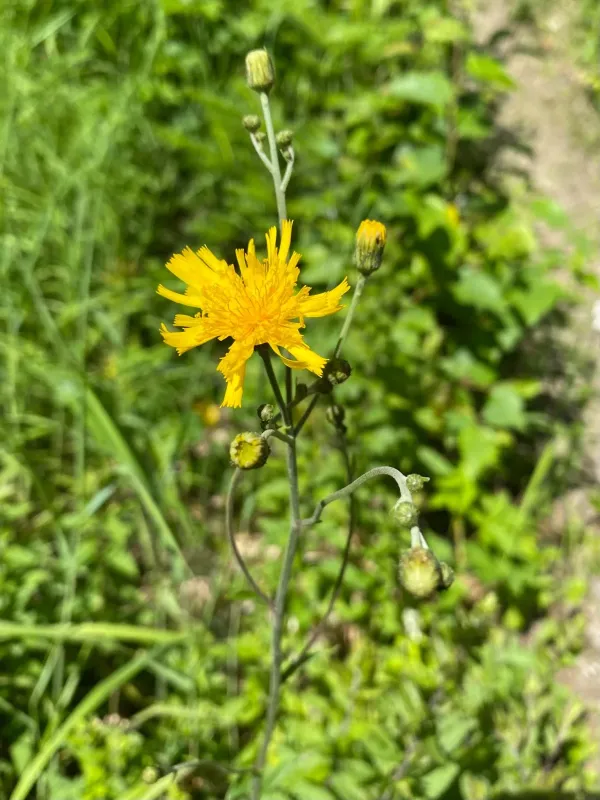
Smooth hawkweed (Hieracium laevigatum) is a perennial herb belonging to the Asteraceae family. It is known for its complex botanical nature and its tendency to hybridize, making it a challenging weed to identify in field settings.
The plant grows a stem up to 80 cm tall, which is typically upright, hairless or sparsely hairy. The leaves are oblong to lanceolate with smooth or occasionally slightly toothed margins, decreasing in size towards the upper part of the stem.
Its inflorescence consists of bright yellow flower heads arranged in a corymbose or paniculate pattern. Like many species in the Hieracium genus, the plant contains a milky latex sap in all its tissues.
The root system consists of a deep-seated taproot, which provides the plant with significant stability and the ability to survive in varied environmental conditions, making mechanical removal difficult.
Propagation occurs primarily through seeds equipped with a feathery pappus, allowing for wide wind dispersal across agricultural landscapes, leading to rapid colonization of open areas.
Where it grows
This species thrives in forest margins, dry meadows, and sandy soils. In agricultural contexts, it is commonly found in perennial forage fields, pastures, and unmanaged fallow lands.
Smooth hawkweed shows high tolerance for nutrient-poor and acidic soils, often appearing in fields where soil fertility management has been neglected or where crop density is low.
It acts as a primary colonizer in disturbed soils, rapidly filling gaps in vegetation coverage after crop harvest or during the early establishment phase of sensitive forage crops.
Infrastructure such as roadsides and field edges often serve as reservoirs for this weed, from which seeds are blown or carried by equipment into production fields.
Its ability to adapt to diverse climates and moisture levels allows it to persist across different regions, acting as a perennial threat to both intensive and extensive farming systems.
Harm it causes
The primary damage caused by smooth hawkweed is competition with crops for essential soil nutrients and water. As a perennial, it depletes soil resources throughout the entire growing season.
In pastures and hay meadows, it degrades the quality of forage. Its milky latex gives the leaves a bitter taste, making the plant unpalatable to livestock, which directly reduces grazing efficiency.
Dense patches of smooth hawkweed can outcompete desirable perennial grasses, leading to a thinner crop stand and a long-term reduction in the overall agricultural productivity of the field.
The robust taproot makes it difficult to eradicate with simple cultivation techniques, as any remaining root fragments can easily initiate new growth, requiring consistent follow-up management.
Shading caused by the weed's leaf rosette and stem growth inhibits the development of crop seedlings, increasing the vulnerability of the field to further weed encroachment and disease.
How to control
Effective management begins with integrated cultural practices, including consistent mowing before flowering to prevent seed set and the depletion of root nutrient reserves.
In cases of heavy infestation, systemic herbicides containing active ingredients such as 2,4-D or dicamba provide the most effective control by targeting the vascular system of the weed.
Crop rotation that includes vigorous annuals can help break the lifecycle of the weed, as repeated soil disturbance through plowing and seedbed preparation makes establishment difficult.
Improving soil pH through liming is a valuable preventive measure, as smooth hawkweed tends to prefer slightly acidic conditions that are suboptimal for many high-yielding crops.
- Regular monitoring of field margins and buffer zones.
- Deep tillage to sever and exhaust taproots in infested areas.
- Using clean, certified seed to prevent the introduction of weeds.
- Sanitizing farm machinery to prevent the spread of seeds between fields.
Taxonomy
- Latin name
- Hieracium laevigatum
- Family
- Сложноцветные (астровые)
- EPPO code
- HIELV