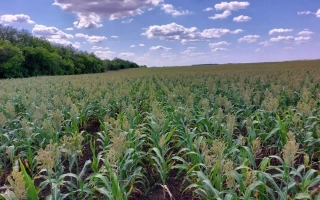
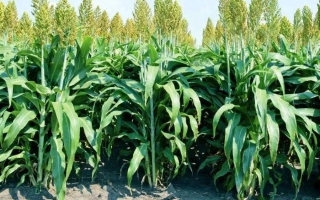
VOLGARI is an early-maturing grain sorghum (Sorghum bicolor) hybrid intended for cultivation in regions with insufficient moisture, such as the Lower Volga region. The medium-height plant possesses above-average drought resistance, making it particularly valuable in hot and dry climates. The mass of 1000 grains ranges from 23.0 to 30.9 grams; the grain is white, elliptical in shape with a rounded back and a weak anthocyanin spot on the tip. The plant's panicle is symmetrical, erect, of medium length, and of medium density at maturity. VOLGARI demonstrates lodging resistance at the level of standards and is weakly affected by bacterial spot and grass aphids, which contributes to stable yields.
Sorghum as a crop is a spring, heat-loving, and very drought-resistant culture, allowing it to develop successfully under insufficient moisture conditions. Seedlings appear uniformly on the 8th-10th day when the soil warms up to 13-15°C, while the optimal temperature for seed germination is 20-30°C. VOLGARI, as an early-maturing hybrid, requires a sum of active temperatures within 2000-2500°C. In addition to soil drought resistance, sorghum also withstands air drought well, and responds positively to irrigation, which allows increasing yield with additional watering.
This sorghum variety is used primarily for grain production and is widely used in agronomy. Its adaptation to complex climatic conditions and resistance to pests make VOLGARI a reliable choice for agricultural production in regions with insufficient moisture, such as the North Caucasus, the Volga Region, and the Far East. High yield and grain quality ensure the economic efficiency of cultivating this hybrid.