

Pest · Lepidoptera (butterflies) · affects Wild cabbage, Apple, Tomato
Especially harmful
Diamondback moth
Plutella xylostella
Description
How to identify
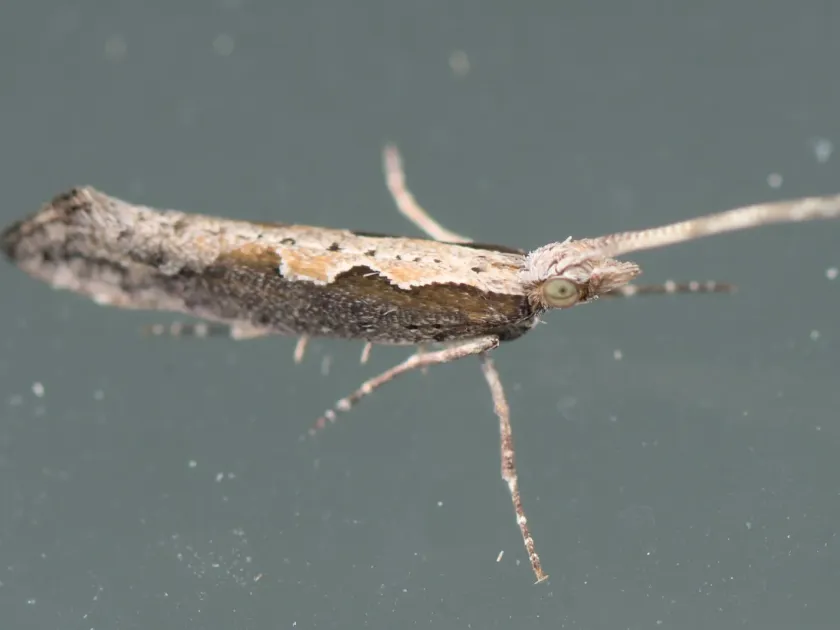
The diamondback moth Plutella xylostella is a significant agricultural pest belonging to the order Lepidoptera and the family Plutellidae. The adult moth has a wingspan of approximately 17 mm.
The wings of the adult moth are narrow, with a characteristic wavy cream-colored stripe along the inner margin, which forms a diamond-shaped pattern when closed.
The larvae are small, spindle-shaped, and reach lengths of up to 12 mm. They are bright green and very active, often wriggling violently and dropping on a silk thread when disturbed.
Pupation occurs within a loose, white or yellowish silken cocoon, which is usually found attached to the underside of the host plant leaves.
The eggs are oval and minute in size, typically laid singly or in small clusters along the veins of the leaves by the female moth.
What it damages
The larvae primarily feed on plants within the Brassicaceae family, including cabbage, broccoli, canola, and mustard. They are considered one of the most destructive pests of these crops globally.
During massive outbreaks, the pest can also attack other agricultural crops, such as sugar beet, potatoes, tomatoes, peas, and alfalfa, depending on the availability of food sources.
Larval feeding can cause complete defoliation, which severely reduces the photosynthetic capacity of the plants and prevents the formation of quality heads in cabbage.
In canola and other oilseed crops, damage to the flowers and pods can lead to significant yield reductions, as the larvae consume reproductive structures.
The pest poses a high risk to plant health, as feeding wounds facilitate the entry of secondary pathogens, including bacterial rot and various fungal diseases.
When it appears
The adult moths appear in early spring once temperatures exceed 10°C. Depending on the local climate and temperature conditions, the pest can complete several generations per season.
Warm, dry weather with temperatures between 20°C and 25°C is optimal for rapid development, leading to potentially explosive population growth in a short time.
The moth typically overwinters in the pupal stage, hiding within plant debris, soil crevices, or on hardy cruciferous weeds that persist through the winter.
Early season generations are usually smaller, but the mid-to-late season generations are often the most damaging due to cumulative population growth.
The movement of moths can be influenced by wind, allowing them to migrate long distances and infest new fields rapidly during the growing season.
Signs of infestation
The first signs of infestation are small irregular "windows" or translucent spots on the leaves, caused by larvae feeding on the lower leaf tissue while leaving the epidermis intact.
As the larvae grow, they consume more leaf material, eventually leaving behind only the larger veins, a characteristic damage pattern known as skeletonizing.
The presence of white silken cocoons on the foliage is a distinct indicator that the pest population has reached a developmental stage where pupation is occurring.
Direct observation of the green, wiggling larvae on the underside of the leaves or at the growing points is the most reliable way to confirm an infestation.
- Wilting of leaves and stunted growth.
- Deformed or absent cabbage hearts.
- Small dark fecal pellets visible on the leaves.
Control measures
Integrated pest management starts with cultural practices such as removing cruciferous weeds and ensuring thorough field sanitation and tillage after harvest to destroy pupae.
Biological control agents, specifically formulations of Bacillus thuringiensis, are highly effective against young larvae and are preferred in sustainable farming systems.
Chemical control is often necessary and involves the rotation of insecticides to manage resistance, as this moth species is notorious for developing resistance to many active ingredients.
Monitoring using pheromone traps is essential to determine the timing of applications, ensuring that treatments are applied when the pest is most vulnerable.
Scouting regularly and maintaining a threshold-based spray program helps optimize the use of pesticides and minimizes the impact on non-target beneficial insect populations.
In brief
10
Damages crops
Content graph
Damages crops · 10
Content graph
Connections · Diamondback moth
Most often together:
Marketplace
Products · 71




Nurel D
Доу АгроСайенсіс, Кінг’з-Лінн, Великобританія
Insecticides
0
0
·
82
7 offers
6.14 €per 1 l
Buy

RELDAN 22 EC
Доу АгроСайенсіс, Кінг’з-Лінн, Великобританія
Insecticides
0
0
·
77
1 offer
2.57 €per 1 l
Buy


Exirel
«Дюпон Інтернешнл Оперейшнз Сарл», Швейцарія
Insecticides
0
0
·
60
4 offers
120.85 €per 1 l
Buy


BENEVIA
«Дюпон Інтернешнл Оперейшнз Сарл», Швейцарія
Insecticides
0
0
·
57
1 offer
302.02 €per pack
Buy


Opercot z.p., (lambda-cyhalotrin, 50 g/kg)
Санрайз Кемікалз Ко. Лтд., Шанхай, Китай
Insecticides
0
0
·
56
3 offers
8.49 €per 1 l
Buy

Insecticide FAS, a.e., (Alpha-cypermethrin, 100 g/l)
«Нанджин Ессенс Файн-Кемікал Ко. Лтд» (Китай)
Insecticides
0
0
·
55
2 offers
18.32 €per 1 l
Buy

Coragen 20, c.s., (chlorantraniliprole, 200 g/l)
«Дюпон Інтернешнл Оперейшнз Сарл», Швейцарія
Insecticides
0
0
·
54
1 offer
59.22 €per 1 l
Buy


VERIMARK
«Дюпон Інтернешнл Оперейшнз Сарл», Швейцарія
Insecticides
0
0
·
53
7 offers
230.73 €per 1 l
Buy

Altex 100 I.U.
China Chemical Industrial & Rice Co. Ltd
Insecticides
0
0
·
52
3 offers
4 €per 1 l
Buy


Fas c.e.
«Нанджин Ессенс Файн-Кемікал Ко. Лтд» (Китай)
Insecticides
0
0
·
40
1 offer
37.5 €per 1 l
Buy


Break m.e., (lambda-cyhalothrin, 100 g/l)
ЗАТ Фірма Август, Росія.,селище Вурнари,
Insecticides
0
0
·
65
No offers
—
Details


Biology
Taxonomy
- Latin name
- Plutella xylostella
- Order
- Lepidoptera (butterflies)
- Family
- Plutellidae
- EPPO code
- PLUTMA
Community
Discussion
No discussions yet — be the first.