
Onion moth
Acrolepia alliella
Description
How to identify
The onion moth (lat. Acrolepiopsis assectella) is a small moth with a wingspan of approximately 12–15 mm. Its forewings are brownish with a distinct whitish spot on the inner margin.
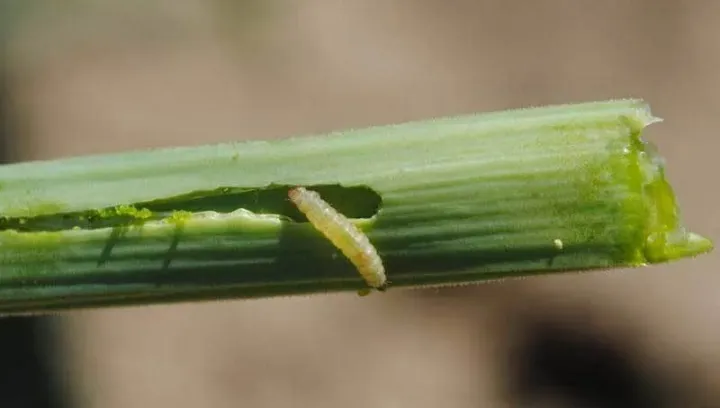
The larvae (caterpillars) reach a length of 10–12 mm. They have a yellowish-green body covered with numerous brown warts, each bearing fine hairs. The head capsule is typically light brown.
The pupa develops inside a loose, net-like silver-white cocoon. This structure is easily visible on damaged plant leaves or in the top layer of the soil once the larval feeding stage is complete.
Adult moths are primarily crepuscular, hiding in sheltered locations during the day. They overwinter as adults in plant debris, under fallen leaves, and in other protected sites.
Systematically, this pest belongs to the family Acrolepiidae, order Lepidoptera, and acts as a specialized phytophagous insect affecting all species within the Allium genus.
What it damages
The primary hosts for this pest include all types of onions (bulb, leek, Welsh, shallot) and garlic. It is widespread in regions where these vegetable crops are cultivated.
The greatest damage is caused by the larvae, which feed on the leaf parenchyma. They create window-like openings or mine long, winding tunnels inside the leaves while leaving the epidermis intact.
Severe infestations cause leaves to turn yellow, dry out, and break, starting from the tips. This leads to weakened plants and a significant reduction in the quality and size of the bulbs.
Damage to young plants during the leaf formation stage can stop the crop's development entirely. If a larva enters the growth point, the bulb often becomes deformed or susceptible to rot.
Damaged tissues create entry points for secondary bacterial and fungal pathogens, which frequently leads to the development of bulb rots both in the field and during storage.
When it appears
The first generation of adult moths emerges in spring when average temperatures exceed 10–12 degrees Celsius. This coincides with the period of active leaf growth for onion crops.
Females lay eggs primarily on the underside of leaves or near the neck of the plant. The incubation period lasts 5 to 7 days, after which larvae emerge and immediately begin feeding.
Depending on the climate, the onion moth can complete 2 to 4 generations per growing season. The peak of infestation intensity often occurs during June and July.
Pupation of the final generation takes place in August or September. Following this cycle, the emerging adults seek overwintering sites in the soil or within decaying vegetation.
Weather conditions significantly impact female fecundity. Hot and dry summers accelerate the life cycle and contribute to a rapid increase in population density throughout the season.
Signs of infestation
The earliest signs of infestation are whitish longitudinal streaks or spots on the leaf surface. These are caused by larvae feeding internally while leaving the outer skin of the leaf visible.
Close inspection often reveals leaf curling. Larvae frequently use silk to pull the edges of leaves together, creating a protected shelter where they continue to feed safely.
Another telltale sign is the presence of larval frass (excrement) inside the leaf mines. Plants may appear wilted, and heavy infestations result in mass yellowing and premature leaf die-back.
In garlic, the signs are similar, though the mining patterns can appear more branched and irregular. Inspection of the leaf whorl may reveal the larvae or their pupal cocoons.
If left unmanaged, distinct patches of infestation become visible across the field. Plants in these areas appear stunted and may emit a foul odor due to the onset of tissue decay.
Control measures
Crop rotation is the most effective cultural control method. It is highly recommended not to replant onions in the same location for at least 3 to 4 years to break the pest cycle.
Thorough removal of plant debris after harvest and deep plowing of the soil are essential. This destroys overwintering sites and reduces the overwintering adult population.
- Use high-quality, pest-free planting stock (sets).
- Perform timely weeding to remove alternative food sources for adult moths.
- Conduct regular monitoring of fields to detect early signs of leaf mining.
- Apply biological insecticides based on entomopathogenic fungi or bacteria.
- Use registered chemical insecticides only when economic thresholds are reached.
Adherence to pre-harvest intervals is critical when using pesticides, especially on green onions. Opt for products with shorter residual periods whenever possible.
Integrated Pest Management (IPM) strategies, including the use of pheromone traps for mating disruption and encouraging local natural predators, provide sustainable control solutions.
Taxonomy
- Latin name
- Acrolepia alliella
- Order
- Lepidoptera (butterflies)
- Family
- Plutellidae
- EPPO code
- ACROAL
Discussion
No discussions yet — be the first.