
Onion moth
Acrolepiopsis betulella
Description
How to identify
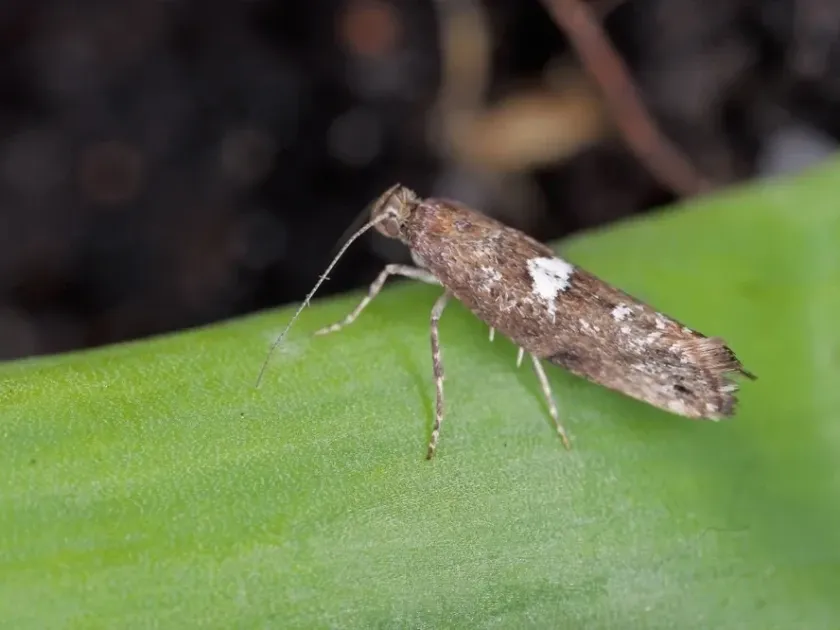
The onion moth (Acrolepiopsis betulella) is a lepidopteran insect belonging to the family Acrolepiidae. It is a small moth with a wingspan of approximately 12–15 mm, characterized by brown forewings with a distinctive white patch on the posterior edge.
As a crepuscular species, the adult moth is most active during twilight and dawn. During the day, they remain hidden under foliage or in soil crevices, which makes them difficult to monitor without the use of pheromone traps.
The larvae, or caterpillars, are the destructive stage of the insect. They reach a length of up to 12 mm and are easily identified by their yellowish-green bodies adorned with brown, wart-like spots on each segment.
Pupation occurs within a loose, lacy, golden-white silk cocoon. These cocoons are typically found on the underside of leaves, in leaf folds, or on plant debris scattered across the field.
Eggs are minute, oval, and pale in color. Females deposit them singly on the leaves or the neck of the plant, often choosing protected spots to ensure the survival of the neonate larvae.
What it damages
The onion moth is an oligophagous pest, feeding exclusively on members of the Allium genus. It poses a significant threat to bulb onions, leeks, garlic, shallots, and chives.
Larvae primarily damage the foliage by mining into the leaves. They consume the internal tissues (mesophyll) while leaving the outer epidermis intact, creating characteristic transparent window-like streaks.
When infestation levels are high, larvae may tunnel down towards the base of the plant, invading the neck and even the bulb. This boring activity often facilitates the entry of pathogens, leading to soft rot.
Damaged plants exhibit reduced photosynthetic capacity, which directly translates into stunted growth and smaller bulb development, significantly affecting yield quality.
In severe cases, the entire leaf or the upper part of the plant may collapse, turn yellow, and wither, rendering the crop unmarketable for both commercial sale and home storage.
When it appears
Adult moths emerge from hibernation in late spring, typically when temperatures consistently remain above 10–12°C. This period often coincides with the initial rapid growth phase of Allium crops.
The onion moth typically completes two to three generations per year, depending on the climatic zone and temperature conditions. Warmer summers lead to shorter developmental cycles.
The second generation is usually the most damaging, as the peak larval activity coincides with the stage when plants are most actively accumulating biomass in the bulbs.
Activity decreases as temperatures drop in autumn. The insect overwinters as an adult in sheltered locations, including garden sheds, crevices in structures, or among crop residues in the field.
Environmental factors, such as humidity and rainfall, play a secondary role in its cycle, although prolonged dry spells can often lead to faster population explosions.
Signs of infestation
Early symptoms include pale, longitudinal streaks on the leaves. These are the result of larval mining. Unlike damage from thrips, these mines are often wider and appear as clear windows.
As larvae grow and move, they cause the tips of the onion leaves to yellow and bend, giving the field a sickly, patchy appearance from a distance.
Closer inspection of the leaves often reveals the presence of frass (larval waste) inside the mines, which is a clear indication of active feeding within the leaf tissue.
The presence of fine, white, net-like cocoons attached to the leaves or near the base of the plant is a definitive indicator of the pest's presence and the completion of its larval stage.
- Transparent or white longitudinal streaks on foliage.
- Withered, yellowing leaf tips.
- Leaf distortion and curling.
- Presence of fine webbing and frass inside the leaf.
- Distinctive lacy, golden-white pupal cocoons.
Control measures
Crop rotation is the most effective cultural practice. Planting Allium crops in a different location each year prevents the build-up of moth populations in the soil and surrounding environment.
Sanitation is crucial; removing and destroying crop residues immediately after harvest prevents the pest from completing its cycle and finding suitable overwintering sites.
Chemical control involves the application of appropriate insecticides. Treatments should be timed precisely to target the larvae before they burrow deep into the protective leaf tissues.
Biological controls, specifically products containing Bacillus thuringiensis (Bt), are highly effective against young larvae and are considered an environmentally friendly alternative to synthetic pesticides.
Using physical barriers, such as fine-mesh row covers, can prevent female moths from laying eggs on the crop, providing excellent protection in small-scale vegetable gardens.
Taxonomy
- Latin name
- Acrolepiopsis betulella
- Order
- Lepidoptera (butterflies)
- Family
- Plutellidae
- EPPO code
- ACLSBE
Discussion
No discussions yet — be the first.