
Garlic moth
Acrolepia manganeutis
Description
How to identify
The garlic moth Acrolepia manganeutis is a small moth belonging to the family Acrolepiidae. The adult insect has a wingspan of approximately 12–15 mm and features brownish-mottled forewings that provide excellent camouflage against dried plant debris.
The larvae, or caterpillars, reach a length of up to 12 mm. They possess a spindle-shaped body with a pale yellowish-green color and a dark brown head capsule, which allows them to remain concealed inside the host plant's leaves.
The life cycle consists of four stages: egg, larva, pupa, and adult. The pupal stage typically takes place within a loose, net-like cocoon attached to the leaves or sheltered spots near the host plants.
Adults overwinter in protected areas, including garden debris, compost piles, or nearby structures. They emerge in the spring as temperatures rise, beginning their reproductive cycle.
Females lay small, yellowish eggs singly or in small clusters on the underside of young garlic or onion leaves, favoring the most succulent parts of the plant for larval feeding.
What it damages
The primary hosts of the garlic moth are plants in the Amaryllidaceae family, specifically garlic, onions, and shallots. The damage is caused exclusively by the feeding activity of the larvae.
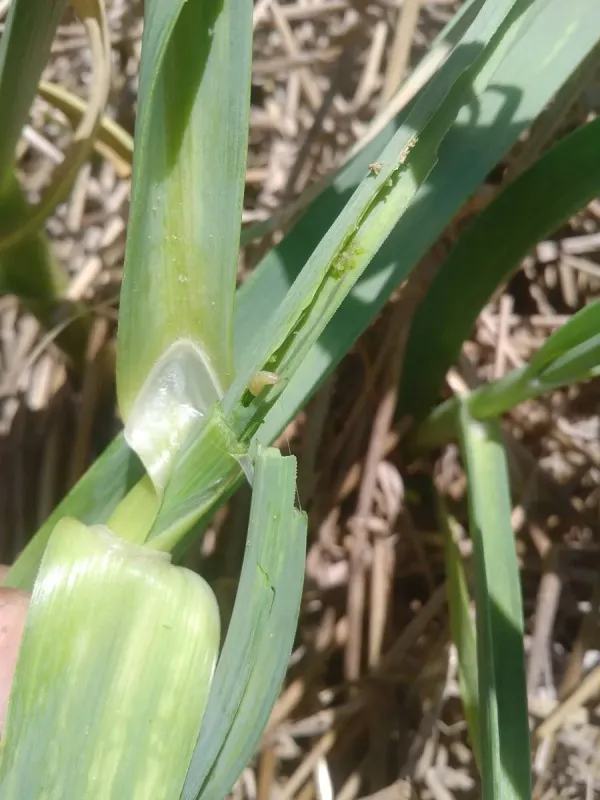
Caterpillars burrow into the leaves, mining the internal tissue. This creates distinct longitudinal white streaks and transparent patches, which significantly compromise the plant's photosynthetic capacity.
Severe infestations can lead to a drastic reduction in bulb size and quality. In many cases, the weakened plant becomes susceptible to secondary infections, such as fungal or bacterial rots that affect storage longevity.
Damage to the central leaf is particularly detrimental as it often stunts the plant's overall growth and development, leading to yellowing and premature death of the foliage.
When infestation levels are high, the aesthetic and economic value of the crop is completely destroyed, making the harvested bulbs unfit for market or long-term storage.
Signs of infestation
The initial signs of infestation include the appearance of thin, white lines or transparent windows on the garlic leaves. These marks indicate where the larvae have mined the internal parenchyma.
As the infestation progresses, leaves show signs of twisting and wilting. The tips of the leaves often turn yellow and die back, providing a clear indication that the plant is stressed.
Closer examination may reveal tiny, dark frass deposits left by the larvae within the tunnels. In advanced cases, the leaf structure may collapse entirely, especially in younger plants.
A telltale sign is the presence of adult moths flying low around the beds during the evening hours, which indicates that egg-laying is likely underway.
If the affected leaf is dissected, one can usually find the larva hiding inside the tunnel, confirming that the damage is indeed caused by the garlic moth.
Control measures
The cornerstone of garlic moth management is sound crop rotation. By moving garlic and onion crops to new locations annually, the pest's cycle is disrupted, reducing population pressure.
Post-harvest sanitation is critical. Removing and burning all plant debris prevents the larvae from completing their life cycle and destroys the overwintering sites for the next generation.
Floating row covers or fine mesh netting can be used during the peak flight periods of the adult moths to prevent them from laying eggs on the vulnerable young plants.
Chemical control should be used as a last resort. Systemic or contact-kill insecticides can be effective if applied during the early stages of larval development, strictly following safety labels.
- Deep plowing in autumn to expose pupae to predators and winter conditions.
- Promoting natural enemies like lacewings and parasitic wasps in the garden ecosystem.
- Monitoring flight patterns using pheromone traps where available.
Taxonomy
- Latin name
- Acrolepia manganeutis
- Order
- Lepidoptera (butterflies)
- Family
- Plutellidae
- EPPO code
- ACROMA
Discussion
No discussions yet — be the first.