
Diamondback moth
Plutella
Description
How to identify
The Diamondback moth (Plutella xylostella) is a small moth with a wingspan of approximately 14–17 mm. Its forewings are brownish with a white, wavy inner margin that forms a distinct diamond shape when the wings are folded.
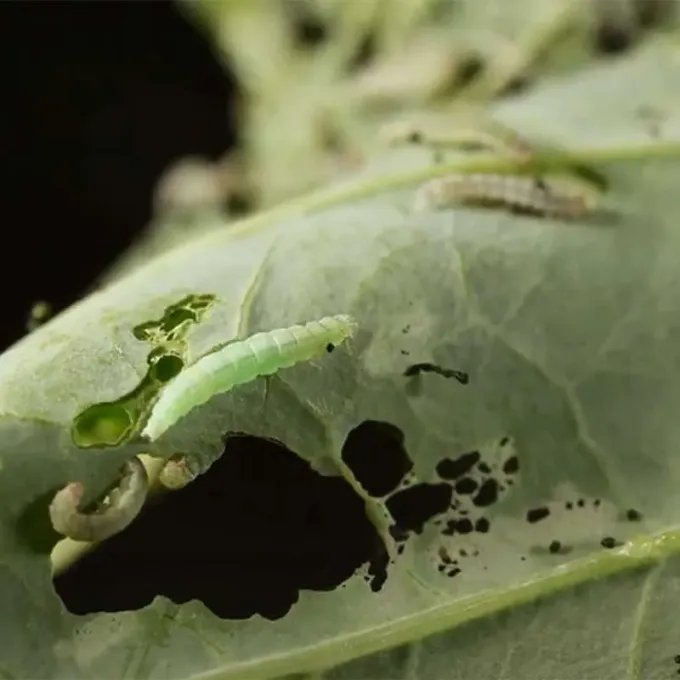
The larvae are bright green, spindle-shaped, and grow to about 10–12 mm long. When disturbed, they exhibit a characteristic wriggling behavior and drop from the leaf on a silken thread.
The pupae are enclosed in a loose, white or pale gray silk cocoon, which is often found attached to the lower surface of the host leaves.
The lifecycle consists of four stages: egg, larva, pupa, and adult. The speed of the life cycle is highly temperature-dependent, allowing for multiple generations per year.
This species is highly adaptable and known for its ability to develop resistance to synthetic insecticides, making integrated management essential.
What it damages
The Diamondback moth primarily attacks cruciferous crops such as cabbage, broccoli, cauliflower, Brussels sprouts, kale, and oilseed rape.
Larvae feed on the leaf tissue, initially creating small "windows" by grazing on the lower epidermis. As they mature, they consume larger holes through the entire leaf.
Damage to the growing point of young plants is particularly destructive, often resulting in stunted growth or the complete failure of head formation.
In high-density infestations, larvae can skeletonize the foliage, leaving only the veins behind, which severely reduces marketability and yield.
While the moth itself does not feed on crops, the economic damage caused by the feeding behavior of its larvae ranks it among the world's most costly agricultural pests.
When it appears
Adult moths become active early in the spring as temperatures rise. They are nocturnal but can also be seen flying in the late afternoon.
The population tends to peak during mid-to-late summer, fueled by consecutive life cycles that overlap as temperatures remain high.
Dry, hot weather often accelerates the reproductive cycle, allowing the moth to complete a full generation in as little as two to three weeks.
In temperate regions, the moth survives the winter in the pupal stage, hidden within plant debris or sheltered spots near the soil surface.
Monitoring for adults should start as soon as cruciferous seedlings are transplanted or appear, using sticky traps with sex pheromones for accuracy.
Signs of infestation
The earliest signs of infestation are small, irregular feeding pits and window-paning on the undersides of leaves caused by young larvae.
The presence of fine, white silk webbing on the leaves is a clear indicator of larval activity, often housing the pests themselves.
Dark granular frass (excrement) accumulates on the leaves, especially in the central whorl of the plant, signaling an active infestation.
Premature yellowing of leaves and the presence of ragged edges on foliage suggest heavy pressure that requires immediate intervention.
Visual identification of adult moths, which take flight in a zigzag pattern when the plant foliage is agitated, confirms the presence of the pest.
Control measures
Cultural control practices include deep plowing after harvest to bury and destroy pupae, effectively breaking the pest's overwintering cycle.
Maintaining a weed-free environment is critical, as wild crucifers often act as alternative hosts that support the moth population before crops are planted.
Biological control using microbial insecticides based on Bacillus thuringiensis is highly effective and safer for beneficial insects.
Chemical control requires alternating products with different modes of action to prevent the rapid development of pesticide resistance in the population.
- Using insect-proof mesh netting
- Implementing regular crop rotation
- Encouraging natural predators like wasps
- Installing pheromone-baited sticky traps
Taxonomy
- Latin name
- Plutella
- Order
- Lepidoptera (butterflies)
- Family
- Plutellidae
- EPPO code
- PLUTSP
Discussion
No discussions yet — be the first.