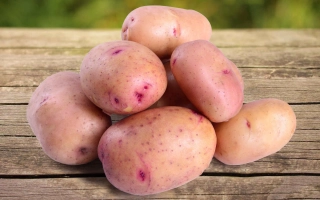
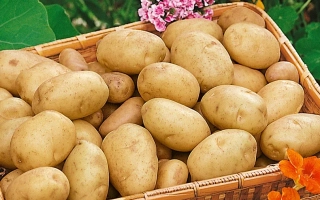
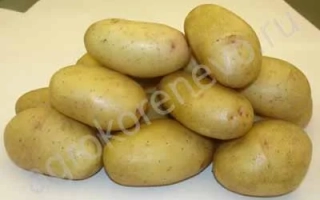
The potato variety Bettina is a medium-early table variety of German selection, characterized by oval tubers with small eyes, yellow skin, and light-yellow flesh. The weight of marketable tubers ranges from 97 to 142 grams, and starch content is from 13.5 to 16%. Plants of this variety have medium or tall growth, intermediate type with upright or semi-upright form. Leaves are medium-sized, green with wavy edges, and the flower crown is small or medium-sized with no or very weak anthocyanic coloring on the inner side.
The Bettina variety is distinguished by high market yield, ranging from 181 to 361 centners per hectare, with maximum yield reaching 385 centners per hectare, significantly exceeding standard varieties. Marketable tuber percentage is 89–97%, and storability reaches 95%, ensuring long-term storage without quality loss. Number of tubers per plant ranges from 8 to 13. The potato has good taste qualities and belongs to the culinary type BC, making it versatile for frying, baking, and boiling.
The Bettina variety is resistant to major potato diseases and pests, including the potato cancer pathogen, pathotype I, golden potato cyst nematode, and has moderate resistance to leaf curl virus and wrinkled mosaic virus. Due to its adaptability to various soil-climatic conditions, this variety is a reliable choice for cultivation in different regions.