


SKU #3501
·
619 views
Apple Renet Simirenko (Renet P. F. Simirenko, Green Renet Simirenko)
Apple
Type of Variety
Winter Apple Variety
Your mark
0 votes
0% positive ratings
Store offers · 1 from 1 store
1 offer in 1 store — from 2.87 € per seedling.
Available at: Панські Сади
Prices are collected automatically from store websites and converted at the current exchange rate. Check the price and availability on the store website before ordering.
Description
A winter variety spread from Platono's farm from the garden of P. F. Simirenko (near the city of Mlyev in the Cherkasy region of Ukraine). Origin unknown: ("…is this an old variety, forgotten in the West, … perhaps this apple was born from accidental sowing of seeds in the gardens of 'Platono's farm'" — writes the outstanding Soviet horticulturist of the early 20th century, Lev Platonovich Simirenko — son of the farm owner, "passionate lover of horticulture" Platon Fedorovich Simirenko, an educated man of his time. A late-winter ripening variety. Distributed throughout southern Russia and southern regions of the Central Chernozem Zone, and throughout Ukraine.
Treevigorous, taller than average, with a wide, rounded, often kettle-shaped, dense crown. Bark of the trunk and branches dark gray with brownish hue, on the sunny side — with an orange tint. Fruit-bearing type — mixed. Fruit-bearing in southern orchards is often expressed on last year’s growth.
Shootsmedium thickness, noticeably curved, straight or slightly bent, greenish-brown, heavily pubescent, with very small, but sparse, stipules. Leaves elongated, egg-shaped, with rounded, in some cases narrowed base and elongated apex, with elongated, twisted tips; strongly curved and strongly folded like a boat, slightly wrinkled in the middle, with fine single or double-toothed margins. Leaf blade forms an angle of 90° or more with the stem. Pubescence medium, light. Color light green, surface slightly glossy, petiole medium-sized, stipules lanceolate or narrowly oval.
Shootsin nursery clearly curved, well-branched.
Flowers medium-sized, saucer-shaped, white, with unpubescent stigmas of medium length, stigma level with anthers. Flowering medium-late.
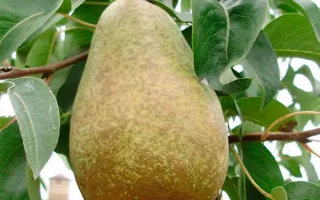
Fruits(Fig.) medium or above-medium, and even large size, shape ranging from flattened conical to flat-round, fruits slightly asymmetric in shape; surface smooth, even. Main color when harvested light green or bright green, with whitish russeting and numerous light, round, large subcutaneous spots. A distinctive feature of the variety is the presence of wart-like formations up to 7 mm in diameter with rusting on the surface, sometimes up to 2-3 per fruit. In southern orchards, the variety is characterized by a dull raspberry tint on the sunny side, especially when harvested late.
Flesh white, tender, very juicy, vinous-sweet, with a pleasant spicy flavor. Chemical composition of fruits: total sugars — 7.5-12.0%, titratable acids — 0.4-0.7%, sugar-to-acid ratio 10-16, ascorbic acid — 7-9 mg/100g, total P-active substances — 97-110 mg/100g.
Typical harvest period — end of September to beginning of October.
Fruitswell retained until harvest. Storage duration — until June, and even longer for orchards with watering — flavor remains harmoniously rich. Commercial quality — depending on agricultural care — 90%.
Fruitsconsumed fresh, possessing high dessert and dietary potential, and the absence of anthocyanins — a necessary condition for treating metabolic diseases.
Self-sterile variety. Best pollinators: Aidored, Korey, Golden Delicious, Kuban Spur, Pamять Sergeevu.
Treesbegin fruiting on vigorous rootstocks at 6 years, on weak-growing rootstocks — at 4-5 years after planting, best yields on the Kuban in the Kuban zone — 250-400 centners per hectare. In early years, trees fruit annually, with age they switch to alternate bearing.
Winter hardiness of Renet Simirenko is weak: even wood of trunks is damaged in the south, but thanks to good shoot-forming ability, the crown recovers fruiting ability already by the third year. It is worth noting the variety’s high drought and heat resistance. Sensitive to scab.
Advantages of the variety:drought resistance, high yield, early fruiting, long storage life of fruits, wind resistance, excellent fruit quality.
Disadvantages of the variety:reduced winter hardiness, alternate bearing of trees, susceptibility to scab and powdery mildew; dense crown.
Crop & resistance
Crop
Specifications
| Type of Variety | |
|---|---|
| Catalog | Catalog → Apple |
No reviews yet. Be the first to share your experience.
Alternatives
Apple saplings · similar varieties


See also
Often considered together with this variety



Champagne Renet (Paper Renet, Remarkable Renet, Paper Renet)
11.3K 3 offers
2.89 €per seedling ≈ 147 ₴


Recently viewed
Products you’ve viewed on this site
Reviews