


SKU #3505
·
1 302 views
Champagne Renet (Paper Renet, Remarkable Renet, Paper Renet)
Apple
User rating
2 votes50% positive reviews
No ratings yet — be the first.
Type of Sort
Winter Apple Variety
Prices in stores
from2.89 €per seedling
pack from 1.97 € per pack
3 offers from 3 stores
Store offers · 3 from 3 stores
Prices are updated on loadLoading offers…
Available at: Demetra · Drevolaz · Саджанці дерев
Aggregator catalog: prices are collected automatically from store websites, normalized by AI and converted at the current exchange rate. Before ordering, confirm the price and availability on the store's website. This block is not indexed by search engines — the data is loaded after the page opens.
About product

A widely cultivated western European winter variety in the past with an uncertain origin. It is encountered today, particularly in the foothill and Black Sea zones of the Krasnodar region, in modern commercial horticulture.
Trees of medium or above-medium growth vigor, with an inverted pyramidal crown in youth or a broad, rounded, cauldron-like crown when fruiting. Branches are directed upwar…
Type of Sort
Winter Apple Variety
Description
A widely cultivated western European winter variety in the past with an uncertain origin. It is encountered today, particularly in the foothill and Black Sea zones of the Krasnodar region, in modern commercial horticulture.
Trees of medium or above-medium growth vigor, with an inverted pyramidal crown in youth or a broad, rounded, cauldron-like crown when fruiting. Branches are directed upward.
Shoots are reddish-brown, hairy, and thickened. Leaves are usually large, oval or egg-shaped, with a rounded base, dark green, dense, thick, with serrated edges, smooth, shiny, and with short, broad stipules.
Late flowering helps preserve flowers in case of spring frosts.
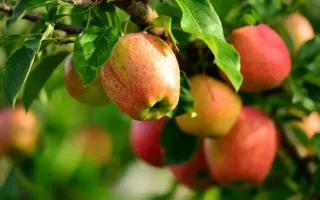
Fruits are usually medium or larger in size, strongly flattened-round in shape, weakly ribbed with characteristic deep longitudinal grooves (ridges). The skin is thin, with a characteristic waxy coating for the variety, and oily to the touch. The primary color at harvest is light green with a delicate, blurred blush resembling a tan on parts of the fruit. As they ripen, fruits acquire a white waxy, later light-yellow coloration. The sun-exposed part of the fruit may occasionally show a delicate pink blush. The peduncle is short.
Flesh is white, juicy, firm, with greenish veins, and tart-sweet. During storage, acidity decreases and the flavor becomes more harmonious.
Harvest maturity of fruits occurs in mid-to-late September; fruits can be stored until April-May. During storage, if temperature drops below 0°C, fruits may develop browning and swelling.
The variety is early-bearing, high-yielding, but insufficiently cold-hardy and susceptible to scab.
Advantages of the variety: early bearing and high productivity of trees, good marketability and storability of fruits, late flowering.
Disadvantages of the variety: significant scab infection, insufficient cold hardiness, irregular fruiting.
Crop & resistance
Crop
Specifications
| Type of Sort | |
|---|---|
| Catalog | Catalog → Apple |
Not yet комментариев. Be the first!
Alternatives
Apple saplings · similar varieties



Renet Simirenko (Renet P. F. Simirenko, Green Renet Simirenko)
0619 2 offers
2.74 €per seedling ≈ 141 ₴
See also
Often considered together with this variety




Recently viewed
Products you’ve viewed on this site
Reviews · 0