


SKU #3504
·
775 views
Renet Chernenko (Renet Kichunova)
Apple
User rating
2 votes100% positive reviews
No ratings yet — be the first.
Type of Sort
Winter Apple Variety
Store offers · 1 from 1 stores
Prices are updated on loadLoading offers…
Available at: Саженцы и семена
Aggregator catalog: prices are collected automatically from store websites, normalized by AI and converted at the current exchange rate. Before ordering, confirm the price and availability on the store's website. This block is not indexed by search engines — the data is loaded after the page opens.
About product

Winter variety selected at the All-Russian Scientific Research Institute of Genetics and Selection of Fruit Crops named after I. V. Michurin. Breeder: S. F. Chernenko. Obtained by sowing seeds of Michurin's Renet Pepinovoy (Pepina chetverogo) from open pollination. Included in the regional variety lists of several areas in the Northwest, Central, Volga-Vyatka, and Central Chernozem regions of Rus…
Type of Sort
Winter Apple Variety
Description
Winter variety selected at the All-Russian Scientific Research Institute of Genetics and Selection of Fruit Crops named after I. V. Michurin. Breeder: S. F. Chernenko. Obtained by sowing seeds of Michurin's Renet Pepinovoy (Pepina chetverogo) from open pollination. Included in the regional variety lists of several areas in the Northwest, Central, Volga-Vyatka, and Central Chernozem regions of Russia.
Trees are vigorous, with round crowns. Main branches have greenish-gray bark, oriented diagonally vertically, individual branches at nearly straight angles. Many twig-like branches (prutiki, kop'yezya, kolyatki) cover the crown. Fruit forms primarily on two-year-old wood, on twigs and shoots from the previous year.
Shoots have reddish-brown bark, turning gray-green toward the base; leaves are medium-sized, elongated with serrated margins, smooth and glossy. Petioles are strongly colored at the base, angled 45º relative to the shoot. Stipules are thread-like.
Flowers are medium-sized, saucer-shaped, almost white with entire, slightly wrinkled petals, stigmas 0.5 cm higher than stamens.
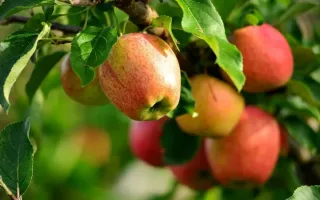
Fruits are medium to large-sized, uniform, flattened-round in shape. Surface is matte. Color is greenish-yellow with faint, diffuse reddish blush on the sun-exposed side, bright red, against which darker stripes and spots are clearly visible. On the colored side, rust-colored subcutaneous spots are noticeable. Peduncles are short and thin, emerging from a small, deep cup with heavily rusted walls; rust sometimes extends beyond the cup. Receptacle is large and open, located in a very wide, deep saucer with slightly ridged walls. Sub-receptacle tube is cup-shaped and does not connect with the seed cavity. Chambers are closed. No central cavity.
Flesh is white, firm, with a pleasant sweet-tart flavor. Chemical composition of fruits: total sugars — 11.2%, titratable acidity — 0.85%, dry matter — 14.9% on fresh weight, ascorbic acid — 24.3 mg/100g, P-active catechins — 229.3 mg/100g.
Fruit ripening is late-winter. Under storage conditions, fruits last until April-May (235 days). Commercial quality is 87%, of which 52% are first-grade.
Trees begin bearing fruit on the 7th-8th year (after grafting), average yield per tree at 15 years old is 62 kg/tree, maximum — 120 kg. Winter hardiness is high.
Fruits and leaves are highly resistant to scab.
Advantages of the variety: high winter hardiness, uniform annual yield, high resistance to scab, long storage life, and high ascorbic acid content.
Disadvantages of the variety: fruits are insufficiently colored and rusted.
Video · 2 videos
Suggest a video →Crop & resistance
Crop
Disease resistance
Specifications
| Type of Sort | |
|---|---|
| Catalog | Catalog → Apple |
Not yet комментариев. Be the first!
Alternatives
Apple saplings · similar varieties


See also
Often considered together with this variety


Champagne Renet (Paper Renet, Remarkable Renet, Paper Renet)
11.3K 3 offers
2.89 €per seedling ≈ 149 ₴




Recently viewed
Products you’ve viewed on this site
Reviews · 0