


SKU #3331
·
456 views
Din Art
Apple
User rating
0 votes0% positive reviews
No ratings yet — be the first.
Type of Sort
Winter Apple Variety
Prices in stores
from8.17 €per seedling
pack from 8.17 € per 1 pcs
4 offers from 3 stores
Store offers · 4 from 3 stores
Prices are updated on loadLoading offers…
Available at: Akb-ok · Optoweek · Солнечный Сад
Aggregator catalog: prices are collected automatically from store websites, normalized by AI and converted at the current exchange rate. Before ordering, confirm the price and availability on the store's website. This block is not indexed by search engines — the data is loaded after the page opens.
About product

Late-winter apple variety of intensive type for short-cycle gardens, triploid, selected by the North Caucasus Regional Research Institute of Horticulture and Viticulture, obtained by mutational selection of mutant hybrid С6-47 (Pepin Shafran x Jonathan) and variety Prima. Authors: S. N. Artiukh, I. A. Rapoport, T. G. Prychko. The variety was introduced into the State Register of Varieties for th…
Type of Sort
Winter Apple Variety
Description
Late-winter apple variety of intensive type for short-cycle gardens, triploid, selected by the North Caucasus Regional Research Institute of Horticulture and Viticulture, obtained by mutational selection of mutant hybrid С6-47 (Pepin Shafran x Jonathan) and variety Prima. Authors: S. N. Artiukh, I. A. Rapoport, T. G. Prychko.
The variety was introduced into the State Register of Varieties for the North Caucasus region in 2002. It is widely cultivated in industrial, farmer, and hobby gardens across the North Caucasus region, covering more than 250 hectares.
Medium-sized tree with a rounded crown. Main branches have light ochre-brown bark, slightly raised upward. Branches are well covered with buds and fruiting spurs, on which the fruits are located. Last year’s growth is usually bearing fruit.
Shoots with greenish-red bark, straight or slightly curved, thin, internodes short. Pubescence on upper part of shoots is moderate. Buds are light-colored, sparse. Leaves are small, light green, egg-shaped with oval base, nearly tubular, with serrated edges, finely wrinkled surface, underside without pubescence, leaves directed upward on shoots. Petiole is short, with a pink spot at the base. Buds are oval, large, slightly pubescent. Flowers are medium-sized, dish-shaped, dark pink with red edges and veins. Buds are purplish. Calyx tube is shallow, funnel-shaped. Style is pubescent, stigma is above stamens. Stamens bases are located in middle of tube. Flowering occurs late.
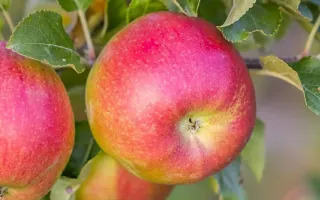
Fruits are large, 180–230 g, slightly flattened-round, height-to-width ratio average, lacking or very weakly ribbed. Main color when harvested is light green, covering color is nearly all surface purplish-pink, blurred. Skin is dense, rough due to subcutaneous whitish spots with slight rusting, round or blurred, sometimes merging, large, dense. Calyx is small, flat or slightly wavy, walls are finely wrinkled; calyx is small and open; calyx lobes are short or medium length. Receptacle is wide or medium-depth, rusting is moderate, appearing as gray wool. Fruit stem is short and medium thickness. Flesh is very dense, creamy, juicy, with slight spicy aroma, which intensifies during storage, harmonious slightly sour-sweet taste. Fruit core is medium width, seed chambers open into it through narrow slit. Seeds are dark brown, cup-shaped.
Fruit quality is high — 90–95 %.
Fruits are valuable for fresh consumption and processing: juices, purees, chips. Storage until May and beyond. Transportability is high. Chemical composition: dry matter — 16.9%, sugar sum — 14.1%, acids — 0.23–0.7%, ascorbic acid — 9.7–12.2 mg/100g, P-active substances — 199.7 mg/100g.
Trees begin fruiting in 2–3 years. In early fruiting period, yield is 70–100 centners per hectare, in full fruiting period — 350 centners per hectare and above. Even under low agronomic practices in the garden, during late spring frosts (April–May 2002, down to -2°C), yield remains consistent due to moderate fruit load and high cell sap concentration in the ovary. Harvest in mid-October.
The variety is self-sterile. Few good pollinators: Aydored, Nympha, Renet Kubanskii, Prichubanskii. Low seed set.
Adaptability of the Din Art variety in testing conditions in the North Caucasus region is high. The variety exhibits stable high resistance to scab and powdery mildew, even in epidemic disease years.
Advantages: ecological adaptability, the variety is practically disease-resistant in apple trees; excellent dessert, market, and technological qualities, and high transportability of fruits. Fruits are not susceptible to diseases during storage.
Crop & resistance
Crop
Disease resistance
Specifications
| Type of Sort | |
|---|---|
| Catalog | Catalog → Apple |
Not yet комментариев. Be the first!
Alternatives
Apple saplings · similar varieties




See also
Often considered together with this variety




Recently viewed
Products you’ve viewed on this site
Reviews · 0