


SKU #3333
·
218 views
Apple Long
Apple
Type of Variety
Autumn Apple Variety
Your mark
0 votes
0% positive ratings
Store offers · 75 from 11 stores
75 offers in 11 stores — from 2.68 € per seedling.
Available at: Agro-market · Drevolaz · fermmash-in-ua · fittonia-ru · GreenBrothers · greenpoint24-ru · moga-eu · moscow-garden24-ru · vihervimma-fi · Интернет магазин садовых растений Все Сорта · zelionii-dvorik-ru
Prices are collected automatically from store websites and converted at the current exchange rate. Check the price and availability on the store website before ordering.
Description
Autumn variety, developed by Hansen in the USA, seedling of unknown small-fruited winter-hardy varieties, seeds which were exported to the USA by him in 1897-1899 from Russia. It was adapted for the West Siberian, East Siberian, Northern and North-Western regions.
Trees medium-sized, with a broadly round crown, with a large number of buds, on which, mostly, fruiting is concentrated.
Shoots dark-purple, slightly hairy. Leaves elongated, many folded like a boat, without hairs, leaf margins slightly wavy, toothed-crenate. Petioles short, without hairs. Stipules large, elongated.
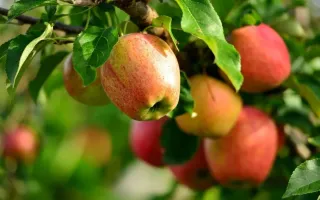
Fruits (see photo) exceptionally small (11-16 g), egg-shaped or oval-conical. Surface smooth. Main color yellow, covering color red, solid, with a dense bluish bloom. Pedicel medium length, thin, reddish, without hairs. Calyx large, closed, with a small, rounded, fused bead-like structure at the base. Subcalyx tube medium, axial cavity absent. Calyx lobes long, narrow, pointed, initially closed, then spreading outwards. Disc not pronounced.
Flesh creamy, often with red veins along the seed cavity line, turns yellow in storage, dense, juicy, sour-sweet, with a peach-like aroma, acceptable taste. Chemical composition of fruits: total sugars — 12.9% (9.7-18.0), titratable acids — 2.42% (2.02-2.99), tannins — 214 mg/100g (145-291), ascorbic acid — 30.8 mg/100g (10.6-62.4), P-active compounds — 281 mg/100g (177-385).
Ripens in early September, capable of being stored for up to 30 days, in storage the flesh softens. Variety for technical purposes.
Begins fruiting in the fourth year. High yield, fruiting irregular. High winter hardiness, moderately resistant to scab.
Advantages of the variety: high winter hardiness.
Disadvantages of the variety: exceptionally small fruits.
Video · 9 videos
Suggest a video →Crop & resistance
Crop
Specifications
| Type of Variety | |
|---|---|
| Catalog | Catalog → Apple |
No reviews yet. Be the first to share your experience.
Alternatives
Apple saplings · similar varieties


See also
Often considered together with this variety





Recently viewed
Products you’ve viewed on this site
Reviews