
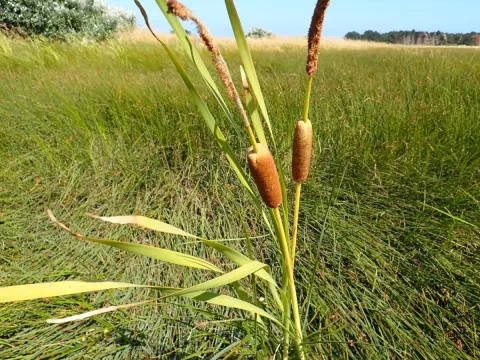
Mueller's bulrush
Typha muelleri
Mueller's bulrush (Typha muelleri) is a perennial herbaceous plant belonging to the Typhaceae family. Native primarily to wetland ecosystems in Australia and Oceania, it acts as a resilient hydrophyte adapted to shallow freshwater environments.
What the section contains
Mueller's bulrush
The plant features a robust rhizomatous root system, which allows it to stabilize soil and expand across waterlogged landscapes. The leaves are tall, linear, and erect, designed to maximize photosynthesis in high-moisture, high-light environments typical of its native range.
Environmental requirements include a consistent water supply, as the plant thrives in saturated soils or standing water. It shows significant adaptability to different water qualities, including slightly brackish conditions, and prefers mud or clay-rich substrates.
Climatic preferences are centered on warm, temperate to tropical conditions. The species is highly productive during long growing seasons, utilizing solar energy to produce substantial amounts of biomass in relatively short timeframes.
Agrotechnical management is relatively low-input, as the species competes effectively with other aquatic vegetation. Proper site selection, focused on stable water levels and nutrient-rich silt, is the primary requirement for establishing a healthy crop.
Harvesting strategies for Typha muelleri typically involve cutting the aerial stems once they have reached maximum maturity, usually toward the end of the growing season when nutrient translocation to the roots is complete.
The economic value of this crop is largely driven by its use in phytoremediation projects. By planting it in man-made wetlands, operators can efficiently remove excess phosphorus, nitrogen, and heavy metals from agricultural and industrial wastewater.
Biomass production is another key utilization area. The high cellulose content of the stalks makes it a viable candidate for the production of biofuels, paper pulp, and sustainable construction materials or textiles.
Historically, certain parts of the plant, including the nutritious rhizomes, have been studied for their potential as fodder. Proper processing is required to remove coarse fibers and increase digestibility for livestock usage.
Sustainability during harvest is paramount. Ensuring that the rhizome mat remains intact allows for the rapid regeneration of the plant cover, ensuring long-term yield and environmental protection of the treated wetlands.