
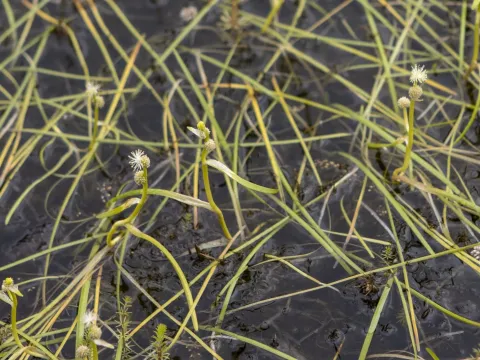
Northern bur-reed
Sparganium hyperboreum
Northern bur-reed (Sparganium hyperboreum) is a perennial herbaceous aquatic plant belonging to the Typhaceae family. It is a highly specialized species adapted to the harsh conditions of the arctic and subarctic climate zones.
What the section contains
Northern bur-reed
The plant originates from the circumpolar regions of the Northern Hemisphere. It primarily inhabits shallow ponds, marshes, and the margins of water bodies, thriving in environments where other species struggle to survive due to low temperatures.
This species requires specific aquatic conditions, including stagnant or slow-moving water and nutrient-rich organic substrates. It has evolved to complete its growth cycle during the short northern summer, utilizing the long daylight hours.
Botanically, it is characterized by its compact size, floating or submerged leaves, and small, spherical inflorescences that develop into prickly bur-like fruits. These seeds are adapted for dispersal by water currents.
In terms of land use, Northern bur-reed is vital for maintaining wetland biodiversity. While not a commercial crop in the traditional sense, it serves as a critical food source for waterfowl and helps stabilize the sediment of arctic wetlands.
The primary threat to the stability of Northern bur-reed populations is the loss of wetland habitats. Drainage projects and the disruption of local hydrology directly impact the availability of suitable growing sites.
The plant is susceptible to fungal infections in its rhizomes, especially when water quality degrades or temperatures fluctuate unpredictably due to regional climate shifts, leading to increased susceptibility to pathogens.
Pests, such as specialized larvae of insects that feed on wetland vegetation, can cause significant damage to the leaf tissue during the peak of the growing season, potentially reducing the overall seed production.
Competition from more dominant invasive aquatic species in southern margins of its range presents a significant risk, as these species can outcompete the slower-growing bur-reed for light and nutrients.
Environmental pollution, specifically the accumulation of heavy metals in arctic water bodies, poses a long-term risk to the health and reproduction of these sensitive aquatic plants.