
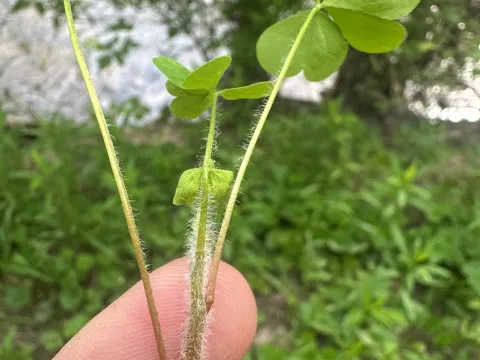
Upright yellow sorrel
Oxalis europaea
Upright yellow sorrel (Oxalis europaea) is a herbaceous perennial belonging to the Oxalidaceae family. In agronomy, it is primarily categorized as an invasive weed that frequently infests cultivated fields, gardens, and nursery areas.
What the section contains
Upright yellow sorrel
Native to North America, the species has been introduced globally and is now naturalized in many temperate regions. Its ability to colonize disturbed ground makes it a common fixture in modern agricultural landscapes.
The plant is characterized by its trifoliate leaves, which resemble clover, and small yellow flowers. It produces unique seed capsules that can discharge seeds over considerable distances, facilitating rapid spread across farm plots.
Regarding environmental needs, it prefers moist, well-drained soils but demonstrates high adaptability. It can thrive in a range of light conditions, from full sun to partial shade, making it a versatile and persistent competitor.
From a хозяйственное usage perspective, it has no agricultural value. On the contrary, its presence is considered a sign of poor field sanitation, as it competes significantly with crops for soil moisture and available nutrients during early growth stages.
The species is susceptible to various fungal pathogens, such as rusts, which can potentially cross-contaminate surrounding high-value vegetable or flowering crops.
Common pests associated with this plant include aphids and spider mites. Because of its prevalence, it often acts as a reservoir host for viruses that can devastate commercial crops.
Management is complicated by its perennial rhizomatous growth. Simple tillage often fails, as breaking the roots encourages vegetative regeneration rather than eradication.
Chemical control often proves difficult due to the foliage's structure, which resists the absorption of many standard post-emergence herbicides.
Integrated weed management remains the best strategy, focusing on hand-pulling before seed set and maintaining dense crop canopies to shade out the low-growing weed seedlings.