
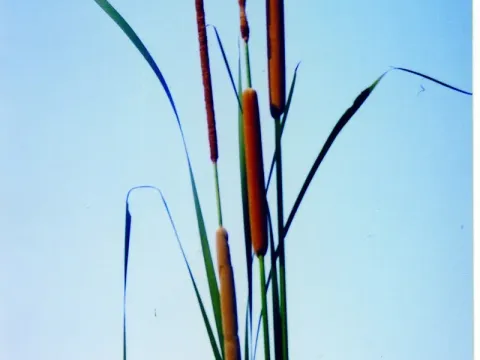
Javanese cattail
Typha javanica
Planting of Javanese cattail is typically carried out in the spring season when the water and soil temperatures reach consistently high levels. The optimal time for planting rhizomes or seedlings is April-May, which allows the plant to adapt to new conditions before the active growing season begins.
What the section contains
Javanese cattail
In agronomic practices, reproduction is most often conducted by dividing rhizomes, as the seed method requires specialized conditions for germination. Parts of the root system are planted into the bottom substrate at a depth of 10-20 centimeters, ensuring planting density for the rapid formation of a continuous stand.
For the establishment of commercial plantations, it is important to maintain a distance between rows of at least 50-70 centimeters. This is necessary to ensure light access and water circulation around each clump, which positively impacts the quality of the raw material obtained.
After planting, monitoring the water level in the water body is required, as sudden drying of the substrate at the initial stage leads to the death of the young root system. In the first weeks after planting, the water level is maintained at minimum acceptable levels.
In regions with cold climates, container culture is possible with subsequent transplanting into open water bodies after the threat of night frosts has passed. This allows for controlling the plant's development at early stages and minimizing planting material losses.
Javanese cattail belongs to the Typhaceae family and is a typical hydrophyte, requiring a constant presence of moisture. The plant prefers well-warmed areas with slow-moving or stagnant water and a bottom substrate rich in organic matter.
The crop shows high requirements for illumination, so open water bodies that are not shaded by woody vegetation are suitable for commercial cultivation. A lack of sunlight leads to elongated shoots and a significant decrease in fiber quality.
The soil should be silty with a slightly acidic or neutral reaction, which provides the best conditions for the growth of a powerful rhizome. Javanese cattail is capable of actively absorbing nutrients from the water, acting as a natural biofilter.
The optimal temperature regime for active vegetative mass growth is in the range of +20 to +30 degrees Celsius. The plant possesses moderate frost resistance, but in regions with harsh winters, rhizomes must be protected by a layer of water that prevents freezing to the bottom.
Agronomy also includes periodic cleaning of water bodies from accumulated debris and excess bottom silt to prevent substrate acidification. A properly organized environment allows the plant to form dense thickets suitable for regular exploitation.
The biomass yield of Javanese cattail depends on planting density, the quality of the bottom substrate, and the temperature conditions of the season. On average, with intensive cultivation, it is possible to harvest significant volumes of the above-ground part of the plant used as raw material.
Productivity assessment is carried out by the dry mass of stems, which undergo a drying process after collection. High levels of nitrogen and phosphorus in the water contribute to faster vegetative mass growth, which allows for increased total yield indicators per hectare.
Economic use includes the application of stems in the production of eco-friendly construction materials and wicker furniture. The quality of the stem is evaluated by its flexibility and strength, which directly depend on the plant's mineral nutrition conditions.
Periodic mowing stimulates the growth of new shoots, which allows for multiple harvests in a single growing season, provided there is sufficient heat supply. Stable plantation exploitation is possible for many years without the need for frequent renewal.
The production structure also considers the harvesting of rhizomes containing starch, which in some regions find use in feed production. Correct calculation of planting density is the key to achieving maximum economic yield indicators.
Major biological threats include insect pests such as cattail aphids and various types of weevils capable of damaging leaves and inflorescences. Mass reproduction of pests can lead to a noticeable decrease in the commercial quality of the raw material.
Fungal diseases developing under conditions of stagnant water and poor air circulation can cause rot in the root zone. Prevention involves controlling planting density and avoiding critical increases in water levels during periods of high humidity.
Stem rust infection is a common problem, especially in years with heavy rainfall and high air humidity. Methods of agronomic adjustment of growth conditions are used to combat pathogens.
Invasive plant species capable of outcompeting Javanese cattail for nutrients have a negative impact. Regular weeding and monitoring of the plantation state are necessary to protect cultural plantings from being overgrown by weeds.
As a protective measure, timely removal of dead plant remains, where fungal spores and insect larvae can hibernate, is recommended. A clean water body ensures a healthy phytosanitary environment for the active growth of cattail.
Harvesting of Javanese cattail is carried out at the end of the growing season when the stems reach maximum maturity and strength, but before their natural degradation process begins. This period usually falls in late August or September.
To cut the stems, manual tools or mechanized mowers mounted on floating platforms are used. It is important to perform the cut as close to the water level as possible so as not to leave stumps that complicate subsequent water body exploitation.
After collection, the raw material undergoes drying under natural conditions under a canopy, which allows for preserving the elasticity of the fiber. Excessive drying under direct sunlight is not allowed, as it makes the material brittle and unsuitable for weaving.
Material sorting is carried out immediately after cutting by stem length and thickness, which allows for separating products into quality classes. A homogeneous batch of raw material significantly increases the market value of finished cattail products.
Storage of dried cattail should be carried out in dry, ventilated rooms, preventing the ingress of moisture. When following all storage rules, the material retains its physical properties for a long time until processing.