
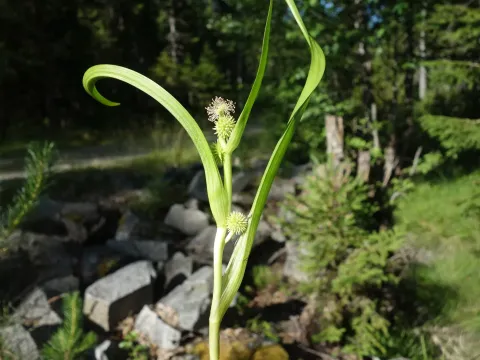
Narrow-leaved bur-reed
Sparganium angustifolium
Narrow-leaved bur-reed (Sparganium angustifolium) is a perennial aquatic plant belonging to the Typhaceae family. It is recognized for its adaptation to submerged and floating-leaved lifestyles in cool, nutrient-poor aquatic environments.
What the section contains
Narrow-leaved bur-reed
The plant originates from the northern temperate and arctic regions of the Northern Hemisphere, including parts of Europe, North America, and Asia. It is commonly found in lakes, ponds, and slow-moving streams with sandy or gravelly substrates.
Botanical characteristics include thin, ribbon-like leaves that are flexible enough to sway with water currents. The inflorescence consists of spherical, burr-like heads, which serve as a distinctive feature for identification within the Sparganium genus.
It requires specific environmental conditions, primarily high water quality and sufficient sunlight penetration. The species is sensitive to drastic water level fluctuations and prefers stable, clear water bodies with low levels of turbidity.
In terms of utilization, it is often employed in ecological restoration and wetland management. Its role in the habitat provides structural complexity that supports biodiversity, offering shelter for small aquatic organisms and nesting materials for waterfowl.
Water pollution and excessive nutrient loading represent the most significant threats, often leading to competitive displacement by invasive macrophytes.
Hydrological changes, including sudden lowering of water levels, can leave the plants stranded, causing severe physiological stress and potential mortality.
Pathogenic fungi can infect the stems and roots under stagnant water conditions, particularly in areas where water exchange is minimal.
Herbivory by waterfowl and certain aquatic insects can periodically reduce biomass, although healthy populations usually recover during the growing season.
Sedimentation from industrial or agricultural runoff alters the substrate texture, which can inhibit the establishment of new root systems and rhizome expansion.