
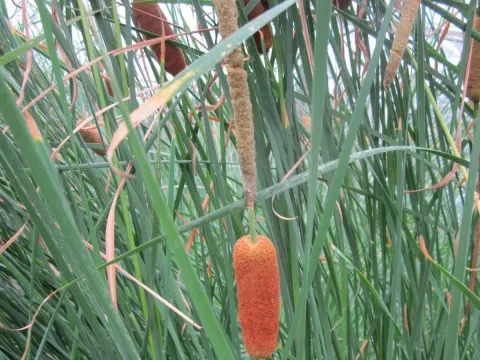
Lyon's bulrush
Typha lugdunensis
Lyon's bulrush (Typha lugdunensis) is a perennial herbaceous plant belonging to the Typhaceae family. It is native to various wetland ecosystems across Eurasia, typically found in coastal zones and marshy environments.
What the section contains
Lyon's bulrush
This species requires a consistent aquatic environment for optimal development. It thrives in shallow waters, ideally ranging from 20 to 50 centimeters in depth, where the root system can remain submerged throughout the growing season.
In terms of soil requirements, the plant prefers silt-rich or organic-heavy substrates. It demonstrates remarkable adaptability to various pH levels, although nutrient-dense environments significantly accelerate biomass production.
The plant is highly heliophilic, meaning it requires full sun exposure to maintain its growth rate. It is winter-hardy and can withstand freezing temperatures, provided that the soil or root zone does not dry out completely.
Economically, Typha lugdunensis is valued for its environmental services. Its primary application in modern agriculture and water management is phytoremediation, where it efficiently extracts excess nutrients from agricultural runoff.
Common pests include various species of stem-boring insects and moths. These organisms can severely affect the structural integrity of the stems, leading to stunted growth or premature lodging of the plant.
Fungal pathogens such as leaf spot are the most frequent health issues. These diseases thrive in overcrowded patches where air circulation is restricted and humidity levels remain consistently high.
Effective management includes maintaining proper spacing between plants to allow for airflow. This simple practice significantly reduces the likelihood of fungal outbreaks and insect colonization.
Another major threat is the over-accumulation of heavy metals or pollutants if the plant is grown in severely contaminated sites without periodic harvesting, which may eventually lead to plant stress.
Regular maintenance, including the removal of dead foliage at the end of the season, is essential to minimize the overwintering of pests and pathogens, ensuring a healthy growth cycle in the subsequent year.