
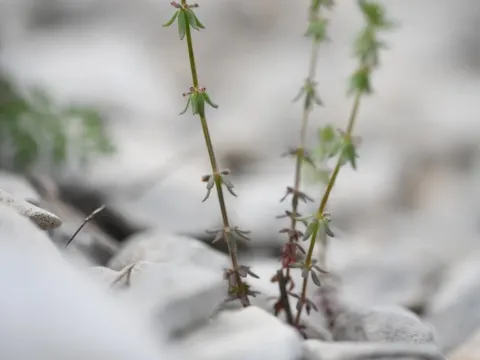
Whorled bedstraw
Galium verticillatum
Whorled bedstraw (Galium verticillatum) belongs to the Rubiaceae family. This annual herb is naturally found in regions with temperate and Mediterranean climates, where it colonizes disturbed sites, dry meadows, and agricultural land.
What the section contains
Whorled bedstraw
The plant is characterized by a slender stem reaching 5–20 cm in height and leaves arranged in whorls along the stem. Its small, discrete flowers develop in axillary inflorescences, which are highly efficient for reproduction in varied environments.
It prefers sunny environments with moderate moisture. The species is highly adaptable to soil types but performs best in well-drained, light soils with a neutral or slightly alkaline pH, making it a persistent presence in many agroecosystems.
In agricultural settings, Galium verticillatum is classified as a weed. It competes with crops for soil nutrients and solar radiation, potentially impacting the yield if infestation densities reach critical thresholds during the crop's development.
While the plant has no significant commercial value, understanding its growth cycle is vital for crop management. Prevention of seed dispersal remains the primary goal to avoid soil seed bank enrichment over successive growing seasons.
The main threats to the plant's survival in fields include shading from taller canopy crops and mechanical soil disruption. The species lacks tolerance for long-term competition in dense crop stands, which naturally suppresses its growth.
- Aphids: Common sucking insects that drain plant sap.
- Powdery Mildew: Fungal infections common during humid, warm weather conditions.
- Weevils: Insects that can cause minor damage to the vegetative parts.
Mechanical control, such as timely inter-row cultivation and seedbed preparation, is the most sustainable method to keep populations of whorled bedstraw at low levels without relying heavily on chemical inputs.
Herbicidal control should be integrated into the broader plant protection program. The timing of application is crucial, targeting the plant during its juvenile vegetative phase to maximize effectiveness and minimize residue.
Preventive measures include using high-purity seed stock to ensure that no weed seeds are introduced into the soil, alongside maintaining strong crop health, which allows the cultivated plants to naturally outcompete the weed.