
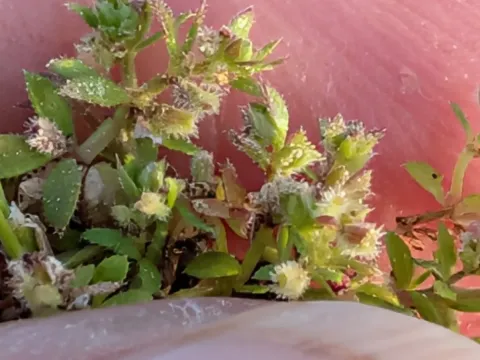
Wall bedstraw
Galium murale
Wall bedstraw (Galium murale) is an annual herbaceous plant belonging to the Rubiaceae family. This species is often observed as a small, non-cultivated plant that thrives in various habitats, including walls, rocky outcrops, and agricultural field margins.
What the section contains
Wall bedstraw
The plant originates from the Mediterranean basin and has spread throughout regions with temperate to subtropical climates. Its natural distribution is largely defined by its ability to colonize disturbed areas where other vegetation struggles to establish during early spring.
Morphologically, Galium murale is characterized by its prostrate or ascending stems and small, whorled leaves. The flowers are extremely small and inconspicuous, facilitating self-pollination which ensures survival in harsh, dry environments where pollinators might be scarce.
Regarding environmental requirements, the plant prefers well-drained, neutral to alkaline soils. It is particularly well-adapted to environments with intermittent water supply and thrives in full sun exposure, which is typical for its Mediterranean place of origin.
From an agricultural standpoint, the plant is typically categorized as a minor weed rather than a crop. Agronomic management involves standard practices such as mechanical soil preparation and, where necessary, the application of selective herbicides to prevent its spread in sensitive crops.
The primary threats to Galium murale in agricultural settings are intense crop competition and modern chemical weed control practices. It cannot compete effectively for resources against rapidly growing cereals or broad-leafed crops that provide dense canopy cover.
Diseases affecting this species often include fungal pathogens like Peronospora species, which thrive in humid conditions and can cause severe leaf blight. Such infections limit the plant's spread and reproductive success within its habitat.
Pests such as aphids and leaf-feeding beetles are commonly found on various Galium species. While these pests can stunt the growth of individual plants, they rarely cause significant economic damage in a commercial farming context due to the plant's size.
Control strategies for farmers focus on early-season cultivation and the use of competitive crop varieties. By maximizing crop density, farmers can effectively shade out Wall bedstraw, preventing it from establishing significant populations that could compete for nutrients.
Although it holds no significant economic value as a commercial crop, Wall bedstraw serves as a part of the ecological mosaic in rural landscapes. Its presence is usually an indicator of specific soil types and a lack of intensive herbicide use in surrounding non-crop areas.