
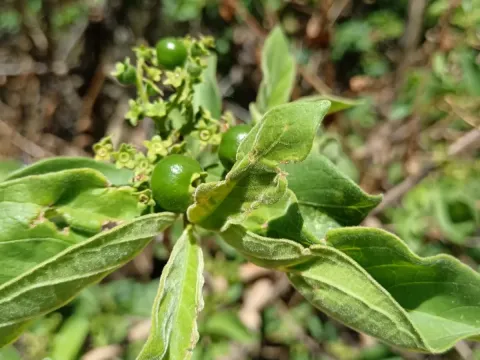
Wild medlar
Vangueria infausta
Wild medlar (Vangueria infausta) belongs to the Rubiaceae family and is a resilient deciduous tree or shrub native to Southern and East Africa. It is well-adapted to savanna environments and woodland regions.
What the section contains
Wild medlar
The plant thrives in well-drained soil types, including sandy loams and rocky terrain, where it can develop a deep and effective root system to withstand prolonged drought periods.
Regarding climate, it requires warm temperatures and full sun exposure for optimal growth and fruit production. It is sensitive to severe frost, which limits its commercial cultivation to frost-free or mild tropical zones.
Agricultural management is relatively simple, requiring minimal intervention once the tree is established. Pruning is recommended to maintain shape and ensure enough light penetration for the inner branches, which boosts yield.
Economically, the wild medlar is significant as a wild fruit crop. Its brownish-yellow, globose fruits are edible and widely used in local diets, offering a distinctive sweet-tart flavor profile.
The crop is occasionally affected by fungal infections that cause leaf spots, particularly during the transition from the rainy season to the dry season.
Pests like scale insects can settle on the stems and leaves, causing stunted growth and reducing the overall vigor of the trees if not managed appropriately.
Fruit-boring larvae pose a significant threat to harvest quality, making it necessary to inspect the fruits regularly during the final weeks of maturation.
In certain habitats, large herbivores and rodents can damage the bark of young trees, which often requires the use of protective fencing around the plantations.
Nematode infestations in the rhizosphere are possible in heavy or poorly managed soils, which can lead to decline in nutrient uptake and eventual yield loss.