
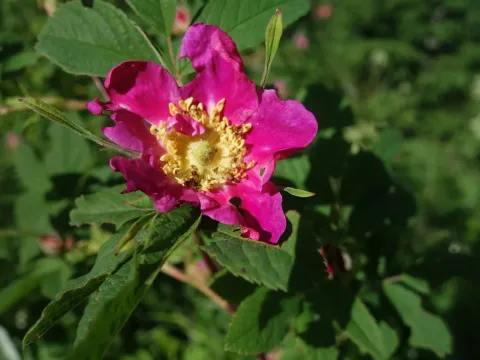
Cinnamon rose
Rosa majalis
Propagation of the cinnamon rose is primarily achieved through seeds or vegetative methods, including root suckers and bush division. Seeds should be sown in autumn immediately after harvesting, as they require a long stratification period for successful spring germination.
What the section contains
Cinnamon rose
If sowing in the spring, seeds must be subjected to artificial stratification for 3–4 months at temperatures between 0 and 5 degrees Celsius. The planting depth should not exceed 1–2 centimeters to ensure sprouts can easily emerge through the soil surface.
Transplanting seedlings to a permanent location is recommended during the autumn before the first hard frosts, or in early spring before sap begins to flow. Maintaining a spacing of 1.5 to 2 meters between bushes is essential for good air circulation within the canopy.
For commercial plantations, it is preferable to use one-year-old nursery-grown seedlings with a well-developed root system. This helps the crop adapt more quickly to the new environment and reduces mortality rates in the first year.
The cinnamon rose is a perennial shrub of the Rosaceae family that naturally inhabits forest edges and river banks. Cultivation requires careful management of its tendency to form thickets, which must be controlled when planning plantation layouts.
The crop prefers well-lit areas, as shade significantly reduces flowering intensity and the number of fruits produced. Despite its resilience, the plant performs best in loamy soils with a healthy layer of humus.
The cinnamon rose is highly winter-hardy, allowing it to be grown in regions with severe climates without additional winter protection. However, young plants require protection during their first few years against drastic temperature fluctuations and drying spring winds.
The soil should have a neutral or slightly acidic pH, and the water table must remain below one meter. Excessive soil moisture is lethal to the root system and promotes the development of root rot pathogens.
Agronomic practices require the application of organic fertilizers, such as compost or manure, during the preparation of planting holes. Subsequent fertilization is carried out annually, focusing on nitrogen in early spring and potassium-phosphorus blends in autumn.
Regular pruning is mandatory to maintain the productivity of mature bushes. It is necessary to remove old, damaged, or diseased branches annually, leaving a mix of shoots of different ages to rejuvenate the crown.
Yields of the cinnamon rose begin to manifest 3–4 years after planting, gradually peaking between 7 and 10 years of age. Fruiting is staggered, requiring a selective approach to harvesting the raw materials.
The average productivity of a mature bush in commercial plantations ranges from 2 to 5 kilograms of fruit. Total yield per hectare depends directly on planting density and the overall level of agricultural management on the site.
The fruits of the cinnamon rose are highly valued in the food and pharmaceutical industries for their high content of ascorbic acid and bioflavonoids. Maximum biological value is achieved when the fruits are fully ripened on the branches.
Factors limiting yield include adverse weather during flowering, such as prolonged rain or late spring frosts. Pest damage to flowers can also significantly reduce the potential volume of the harvested product.
To increase yields, it is recommended to maintain optimal soil moisture during fruit set and active growth. Drip irrigation during dry spells significantly improves the commercial quality of the fruits.
The most dangerous diseases for the cinnamon rose include powdery mildew, appearing as a white coating on leaves, and rust, which causes orange pustules. Broad-spectrum fungicides are typically used to control these outbreaks.
Among pests, rose aphids, which suck sap from young shoots, and spider mites cause serious damage. Leaves infested by pests often curl, leading to premature leaf drop and the overall weakening of the shrub.
Sawflies are capable of causing significant damage to generative organs by attacking buds and flowers. Regular monitoring of the plantation allows for timely application of insecticides during the early stages of parasite reproduction.
Various forms of leaf spot can lead to premature defoliation, which negatively affects the plant's winter hardiness. Preventive spraying with Bordeaux mixture in spring and autumn is considered a basic protective measure.
An important element of plant protection is adhering to sanitary standards on the plantation: collecting and burning fallen leaves and removing heavily infected branches. This dramatically lowers the infectious background in the orchard.
Harvesting cinnamon rose fruits begins during the stage of full biological maturity, when the skin acquires a rich bright red color. Depending on the climatic zone, this period usually occurs in August or September.
To preserve the maximum number of vitamins, fruits should be harvested in dry weather. It is important not to damage the skin, as this leads to a rapid loss of nutrients and the development of fungal infections during storage.
After harvesting, fruits must be sent for processing or drying as soon as possible. Drying is carried out at temperatures no higher than 60–70 degrees Celsius, preserving the product's biological value and preventing charring.
Transportation of the crop should occur in ventilated containers, such as wooden crates or mesh bags. Long-term storage of fresh, unprocessed fruit is prohibited due to the high risk of rapid spoilage.
After the harvest season, a final inspection of the bushes is conducted to assess their condition before winter. Sanitary cleaning is performed to remove remaining stalks if mechanical harvesting equipment was used.