
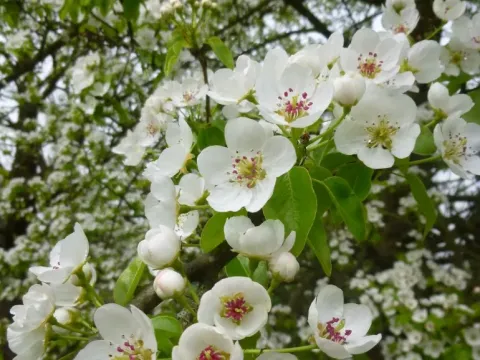
Wild pear
Pyrus pyraster
The wild pear (Pyrus pyraster) is a deciduous tree belonging to the Rosaceae family. It is a robust species known for its longevity and its significant role as a progenitor for modern cultivated pear varieties.
What the section contains
Wild pear
This tree thrives in a variety of conditions, showing a preference for sunny, open areas with well-drained, nutrient-rich soils. However, its natural resilience allows it to persist on poorer, drier sites where many other fruit trees might fail.
Geographically, Pyrus pyraster is native to much of Europe and Western Asia. It is frequently found in broad-leaved forests, on hillsides, and as a component of woodland edges, providing a vital food source for wildlife.
In agriculture, the wild pear is primarily valued as a hardy rootstock. Its vigorous root system is highly compatible with domestic pear cultivars, imparting drought resistance and longevity to the grafted trees.
Management in a cultivation setting requires minimal intervention once the tree is established, focusing mainly on pruning for health, ensuring proper air circulation within the canopy, and protecting young stems from damage.
Wild pear trees typically reach sexual maturity and begin producing fruit between 8 and 12 years of age. The yield is generally lower than that of intensively cultivated varieties, but it remains consistent under favorable weather conditions.
The fruits are usually small, globose or pyriform, and often contain tannins that give them an astringent taste, making them less suitable for fresh consumption but excellent for processing into fermented products.
The productivity of the wild pear is heavily influenced by site factors, such as light availability and moisture levels. High light exposure significantly improves the flowering capacity and subsequent fruit set.
While not a primary commercial crop for fruit production, the yield of Pyrus pyraster is essential for biodiversity in orchards and forest environments, supporting numerous bird and insect populations.
Fruit production is often cyclical, with years of heavy crops followed by years of lower yield, allowing the tree to conserve resources and maintain its long-term growth and structural integrity.
The wild pear is susceptible to various fungal pathogens, most notably pear scab (Venturia pyrina), which can cause spots on leaves and fruits, affecting the overall aesthetic and health of the tree.
Fire blight, caused by the bacterium Erwinia amylovora, poses the most severe threat. It can cause rapid wilting and necrosis of branches, requiring strict sanitary measures such as pruning and destroying infected wood.
Pests such as aphids and spider mites frequently infest young shoots and leaves, hindering photosynthesis and tree growth. Integrated pest management, including natural predators, is usually sufficient to keep populations in check.
The codling moth is a major pest for the fruits. Infestation leads to premature fruit drop, which can be mitigated through monitoring and the use of physical barriers or targeted treatments if necessary.
To ensure tree longevity, practitioners should maintain clear, debris-free orchard floors, which reduces the overwintering capacity of pests and fungal spores, promoting a healthier growing environment.
Harvesting wild pears is typically carried out in late summer to early autumn, when the fruit reaches maturity and changes color. They are often collected when they begin to fall naturally from the tree.
Because the fruits are often firm and tart, they are frequently gathered in bulk for processing. Mechanical aids or simple shaking methods are commonly used to expedite the collection process.
For culinary use, harvested fruit should be stored in cool, ventilated containers to prevent moisture accumulation and decay. Proper sorting ensures that only healthy, undamaged fruit enters the storage phase.
The fruit serves as a valuable resource for artisanal production, including vinegar, spirits, and dried snacks, where the unique flavors of the wild variety can be preserved and highlighted.
When harvesting, it is important to preserve the tree's health by avoiding damage to the bark and buds, as the wild pear is often maintained for a long lifespan, both for its fruit and its role as a stock.