
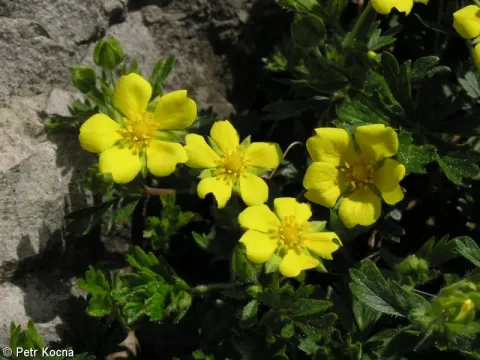
Potentilla praecox
Potentilla praecox
Potentilla praecox, commonly known as early cinquefoil, is a perennial herbaceous plant belonging to the Rosaceae family. Native to European regions, it typically inhabits dry grasslands, rocky slopes, and sunny forest edges, showcasing its adaptation to nutrient-poor and exposed environments.
What the section contains
Potentilla praecox
The plant thrives in light, well-drained soils, ranging from sandy to loamy textures. It possesses a high degree of adaptability to soil pH, although neutral to slightly alkaline substrates are generally preferred for optimal growth and proliferation of its characteristic rosettes.
Light exposure is the most critical environmental factor for Potentilla praecox. It is a heliophilous species that requires full sun to maintain its compact, low-growing form; insufficient light exposure leads to etiolation, which significantly compromises its structural and aesthetic integrity.
This species is highly drought-tolerant, utilizing its physiological mechanisms to survive periods of limited rainfall. While it can withstand harsh dry spells, supplemental irrigation during extreme droughts can significantly enhance its vigor and the duration of its blooming season.
Potentilla praecox exhibits excellent cold hardiness, surviving winter temperatures common in temperate climates without requiring additional protection. Its ability to form a dense, uniform mat makes it a valuable asset for soil erosion control and low-maintenance landscape design.
Spider mites are the most frequent pests affecting Potentilla praecox, particularly during dry and hot summer months. These mites infest the foliage, leading to stippling and eventual necrosis of the leaves, which necessitates timely intervention with suitable acaricides.
Powdery mildew is a prevalent fungal disease that thrives in humid environments with poor air circulation. It manifests as a white, dusty fungal growth on the leaves, which can be managed by improving site ventilation and applying systemic fungicides when initial symptoms appear.
Leaf spot diseases, caused by various fungal pathogens, can affect the plant during periods of high humidity. These infections often result in dark or discolored spots on the foliage, potentially leading to premature senescence if left untreated by appropriate chemical controls.
Root rot represents a severe threat to the plant, primarily occurring in poorly drained or waterlogged soils. Prevention is essential, focusing on selecting sites with natural drainage and avoiding excessive irrigation practices that saturate the root zone for prolonged periods.
Slugs and snails can cause mechanical damage to the tender leaves, especially in protected or overly damp garden corners. While generally not fatal to the plant, significant grazing can reduce its vigor and aesthetic quality, requiring the use of barrier methods or bait stations.