
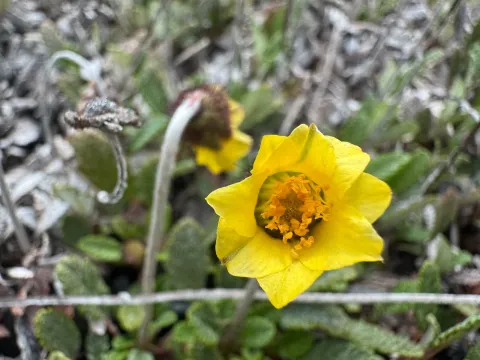
Drummond's dryad
Dryas drummondii
Drummond's dryad (Dryas drummondii) is a prostrate, evergreen subshrub belonging to the Rosaceae family. This species is native to the northern and mountainous regions of North America, where it thrives in harsh, exposed environments.
What the section contains
Drummond's dryad
The plant features woody, mat-forming stems that create a dense ground cover. Its leaves are distinctively oblong with serrated margins and a characteristic white, felt-like underside, which is an adaptation to preserve moisture.
Cultural requirements include well-drained, nutrient-poor soil, preferably of an alkaline or rocky nature. Providing an excellent drainage system is essential, as the plant cannot tolerate waterlogged conditions which lead to root rot.
Optimal growth is achieved in full sun exposure. While it is highly cold-hardy, the plant requires significant light to maintain its tight, carpet-like habit and to promote the development of its unique nodding, yellow flowers.
Drummond's dryad is highly valued for erosion control and soil stabilization on rocky slopes. Its symbiotic relationship with nitrogen-fixing actinomycetes makes it an essential pioneer species for soil enrichment and ecological restoration projects.
The most significant threat to the health of Drummond's dryad is poor soil aeration and water stagnation. Prolonged damp conditions inevitably lead to the development of crown rot, which can destroy large mats rapidly.
During the growing season, if the planting site lacks adequate air circulation, the foliage is susceptible to fungal infections. Ensuring proper spacing between plants helps to mitigate this risk significantly.
Pests are generally not a major concern; however, in dry and hot conditions, spider mites may appear on the foliage. Maintaining healthy growing conditions through consistent, moderate irrigation prevents severe infestations.
Weed management should be handled with care to avoid disturbing the shallow, delicate root system. Using a gravel mulch is a highly recommended practice, as it suppresses weeds while keeping the root crown dry.
Winter injury can occur if the plant is exposed to excessive moisture during freeze-thaw cycles. Adequate drainage is the primary defense against the deleterious effects of winter climate on this evergreen species.