
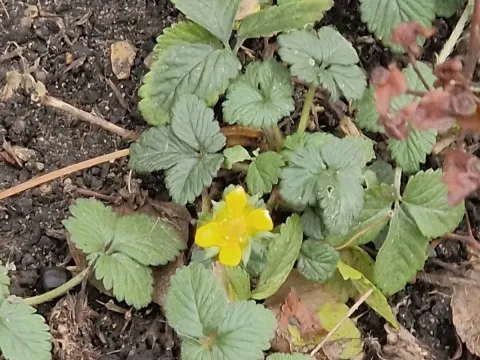
Duchesnea
Duchesnea
Propagation of Duchesnea indica is primarily performed vegetatively by rooting runners, which the plant produces in large quantities throughout the season.
What the section contains
Duchesnea
The most favorable period for planting is in the spring, once the soil has warmed up sufficiently, ensuring active root development and establishment.
While seed propagation is technically feasible, it is less common due to the extended germination time and the requirement for cold stratification.
When establishing a patch, it is recommended to space the plants 20–30 cm apart to allow for rapid expansion and the formation of a dense, carpet-like cover.
Late summer or early autumn is also a suitable time for transplanting and dividing established clumps, provided there is enough moisture for root recovery.
As a member of the Rosaceae family, Duchesnea is highly adaptable and can thrive in a wide variety of ecological niches and soil types.
The plant prefers partial shade but is remarkably tolerant of full sun exposure, provided that consistent moisture levels are maintained during dry periods.
It is not demanding regarding soil fertility, growing successfully in poor or compacted soils, though it performs best in well-drained, organic-rich substrates.
Irrigation management is essential in hot climates to prevent leaf scorch and to ensure the continuous production of the characteristic red berries.
Duchesnea exhibits good cold hardiness and is capable of surviving winter conditions in various temperate regions with minimal protection.
The primary threats to Duchesnea are fungal diseases, particularly leaf spot pathogens that thrive in environments with poor air circulation and high humidity.
Leaf deformation caused by mites, such as the strawberry mite, can be a significant issue, leading to stunted growth and reduced aesthetic appeal.
Slugs and snails often feed on the foliage and the ornamental fruits, particularly in damp and overcrowded plantings where they can hide easily.
Preventative measures include thinning the plants to improve airflow and applying appropriate fungicides or acaricides if a pest population establishes itself.
Regular monitoring for signs of infestation or infection allows for early intervention, ensuring the long-term health of the ornamental ground cover.