
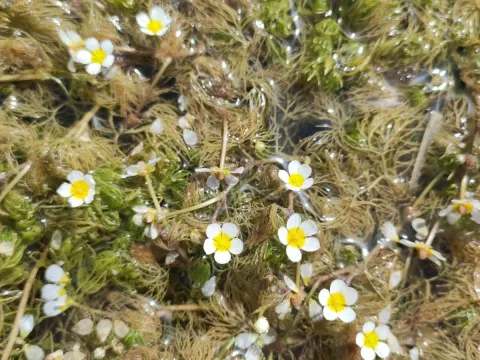
Rion's buttercup
Ranunculus rionii
Rion's buttercup (Ranunculus rionii) is an aquatic annual herbaceous plant belonging to the Ranunculaceae family. Unlike terrestrial buttercups, this species has fully adapted to an aquatic environment, thriving in shallow water bodies with slow or stagnant flow.
What the section contains
Rion's buttercup
The plant features slender stems and highly dissected leaves, which are critical adaptations for absorbing nutrients directly from the water column. Its root system is relatively rudimentary, serving mainly for anchorage in the substrate rather than nutrient uptake.
Optimal growth is achieved in well-lit environments with stable water levels throughout the growing season. The plant prefers temperate climates and is commonly found in ponds, ditches, and wetlands where water temperature remains favorable for rapid biomass development.
While soil quality is not the primary factor for growth, silty or organic-rich sediments at the bottom of the water body facilitate healthier plant development. The plant is highly sensitive to water chemistry and thrives best in waters with moderate mineral content.
The primary use of Rion's buttercup is ecological, as it contributes to water oxygenation and provides habitat for various aquatic invertebrates. In some managed ponds, it can serve as a natural filter, though it is rarely treated as a commercial agricultural crop.
The main threats to the plant include water pollution, excessive use of herbicides in nearby fields, and eutrophication. High levels of nitrogen and phosphorus encourage the growth of algae, which effectively shades out the plant and disrupts its life cycle.