
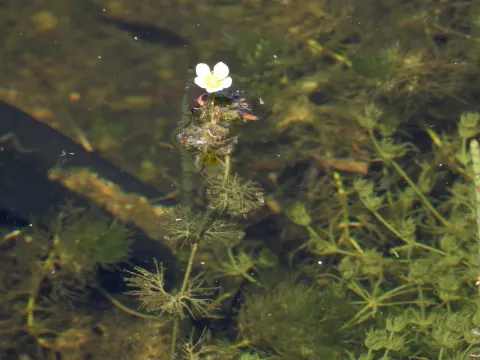
Rigid hornwort
Ranunculus circinatus
Rigid hornwort, or Ranunculus circinatus, is a perennial aquatic plant belonging to the Ranunculaceae family. Unlike conventional crops, it is a submerged hydrophyte, adapted to living entirely under the water surface in freshwater environments.
What the section contains
Rigid hornwort
The plant thrives in standing or slow-moving bodies of water such as ponds, lakes, and ditches. It shows a preference for muddy or calcareous bottoms, where it can firmly anchor itself and spread through dense vegetative growth.
Adequate sunlight penetration is essential for the healthy development of this species. In highly turbid or eutrophic waters, where light levels are restricted by algal blooms, the plant struggles to photosynthesize effectively and eventually declines.
As a bioindicator, the presence of healthy patches of Ranunculus circinatus is a sign of good water quality. It helps maintain the clarity of its habitat by absorbing excess nutrients, thus preventing the degradation of aquatic ecosystems.
Maintaining a balanced aquatic environment is the key requirement for its growth. Management involves monitoring water clarity and preventing chemical runoff, which is necessary to ensure the plant's survival and its ecological contribution to the fish habitat.
Harvesting Ranunculus circinatus is not a standard agricultural practice but rather a water management activity. It is primarily performed in aquaculture or irrigation channels where excessive growth can impede water flow and fish movement.
Mechanical harvesting is conducted using specialized aquatic vegetation cutters. These machines are designed to remove biomass from the water column without damaging the bottom sediments or disrupting the local spawning areas of fish species.
The harvested plant material is rich in organic nutrients, particularly nitrogen and phosphorus. Once composted, it can serve as a high-quality organic amendment for land-based agriculture near the water source.
Selective harvesting is recommended over complete removal. Leaving clusters of the plant is vital to sustain the micro-ecosystem, as these beds are essential for the survival of macroinvertebrates and fish fry.
There is no industrial-scale cultivation of this species for commercial trade at this time. Its value is recognized primarily in ecological restoration and the maintenance of artificial water storage systems.
Eutrophication is the most significant threat to the survival of Ranunculus circinatus. Runoff containing agricultural fertilizers stimulates massive algae growth, which blocks the sunlight required by the plant, leading to its death.
Herbicides and pesticides entering water sources from nearby fields pose an acute threat to the plant's physiological integrity. Even sub-lethal concentrations can interfere with its growth cycles and reproductive health.
Invasive species represent another major challenge, as they often compete more aggressively for nutrients and light. This competition can significantly reduce the range of the rigid hornwort, leading to a loss in botanical diversity.
Severe changes in water levels, such as periodic droughts or excessive water extraction for irrigation, can lead to the desiccation of the plant. Once a population is destroyed by drying, recolonization is often difficult and slow.
Climate-induced temperature increases in shallow water bodies can create heat stress for the plant, making it more susceptible to pathogen attacks and reducing its overall resilience against changing environmental conditions.