
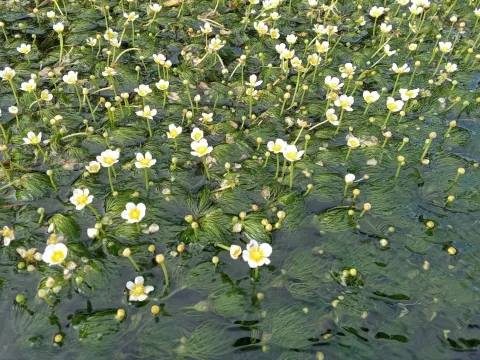
Nippon buttercup
Ranunculus nipponicus
Nippon buttercup (Ranunculus nipponicus) is a perennial aquatic plant species belonging to the Ranunculaceae family. It is a specialized aquatic herb adapted to thrive in clear, flowing water environments, distinguishing it from most terrestrial buttercup varieties.
What the section contains
Nippon buttercup
The native range of this species is primarily focused in East Asia, with Japan being the core region of distribution. It is typically found in high-quality riverbeds, alpine streams, and cool, oxygen-rich freshwater environments.
Botanically, the species exhibits distinct morphological adaptations. It possesses finely dissected submerged leaves, which minimize resistance to water currents, and broader floating leaves that are essential for respiration and light absorption on the water surface.
The cultural requirements for this plant are stringent, specifically regarding water quality. It requires high dissolved oxygen levels and a stable pH. It does not tolerate high concentrations of agricultural runoff or heavy sedimentation, which can smother its delicate growth structures.
In terms of agricultural and landscape usage, the Nippon buttercup is primarily valued for its role in ornamental aquatic planting and ecological restoration. It serves as an indicator of high water purity in sustainable aquaculture projects and bio-design for public water features.
The primary health threats to this species include fungal infections that manifest when water flow is insufficient, leading to stem and leaf tissue necrosis. Stagnant water conditions promote the growth of detrimental pathogens that can rapidly devastate a colony.
Regarding pest pressure, various aquatic snails and insect larvae are the most significant threats. These organisms can consume the plant's vegetative mass, and in enclosed or poorly managed aquatic systems, such infestations can lead to total loss of the planting material.