
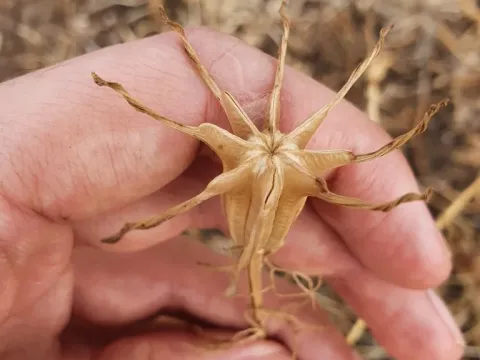
Nigella sativa
Nigella
Nigella sativa, commonly known as black seed or black caraway, is an annual flowering plant in the Ranunculaceae family. It is typically sown directly into the soil in early spring once the threat of heavy frost has passed and temperatures are consistently above 10 degrees Celsius.
What the section contains


Nigella sativa
The seeds are relatively small and should be planted at a shallow depth of about 1 to 2 centimeters. Proper soil-to-seed contact is essential for germination, so the soil should be lightly firmed after sowing to retain moisture.
Optimal row spacing ranges between 25 and 30 centimeters, which allows enough space for the plants to develop lateral branches while ensuring the field remains easy to cultivate and weed during the early growth stages.
Because the initial growth phase of Nigella is slow, weed control during the first four to six weeks is crucial. Farmers often use precise mechanical hoeing or mulching techniques to ensure the crop is not choked by invasive weeds.
Successive sowing can be practiced in mild climates to extend the harvest window, although the main production cycle is usually concentrated in the spring-to-summer period to allow for full maturation of the seed pods.
Nigella sativa thrives in full sun and requires at least 6 to 8 hours of direct light daily. The plant is highly sensitive to shade, which significantly reduces flower production and, consequently, the final seed yield.
The crop is adaptable to various soil types but performs best in well-drained, sandy loam soils. It does not tolerate waterlogged conditions, which can lead to rapid root rot and overall plant failure.
Regarding soil pH, a neutral to slightly alkaline environment (6.0 to 7.5) is preferred. Soils that are overly acidic should be amended with lime well before the planting season to improve nutrient uptake.
While the plant can withstand cool temperatures, it requires a warm, dry climate during the flowering and seed-setting stages to ensure high oil quality in the seeds. Excessive rain during the harvest period can be detrimental to seed quality.
Fertilization should be handled with care; excessive nitrogen can promote excessive foliage growth at the expense of seed production. A balanced fertilizer applied before sowing is usually sufficient for a healthy crop.
The yield of Nigella sativa varies depending on environmental conditions and crop management. Under optimal farming practices, yields generally fall within the range of 500 to 1,000 kilograms of seeds per hectare.
Cross-pollination by bees and other beneficial insects is essential for maximizing yield. Placing hives near the field can improve fruit set and lead to more uniform development of the seed pods across the plantation.
Maintaining proper plant density is critical; overcrowding leads to smaller pods and higher susceptibility to diseases. A density of 20 to 30 plants per square meter is considered ideal for commercial-scale production.
Seed quality is measured not only by weight but also by the thymoquinone content, which is influenced by the heat and sun exposure received during the maturation phase. Proper irrigation management is key to maintaining these qualities.
Regular monitoring for pests and diseases, coupled with timely weed control, ensures that the plants divert most of their energy into producing seeds rather than competing for resources, directly boosting the final output.
Root rot is the most common issue for Nigella sativa, particularly in fields with poor drainage or during seasons with excessive rainfall. Preventive measures include ensuring good soil aeration and avoiding low-lying areas for planting.
Powdery mildew can manifest during periods of high humidity and limited airflow. To mitigate this, farmers should ensure adequate spacing between rows to promote air circulation within the plant canopy.
Aphids are the primary insect pest, often clustering on the tender parts of the plant and sucking the sap. If left uncontrolled, they can cause stunted growth and reduced seed yield, necessitating the use of targeted biological controls.
Cutworms can cause significant damage to young seedlings at the emergence stage. In areas with high pest pressure, integrated pest management (IPM) strategies, including crop rotation, are highly recommended to keep populations in check.
By rotating crops every 3 to 4 years, farmers can effectively disrupt the life cycle of soil-borne pathogens and pests, ensuring that the fields remain suitable for healthy Nigella cultivation season after season.
Harvesting usually takes place in late summer or autumn when the seed pods have turned from green to a brownish, dry color. At this point, the seeds inside are typically mature and black.
It is vital to harvest before the pods fully dehisce or crack open, as the seeds shatter easily. If the weather is dry, many farmers cut the plants, bundle them, and hang them to dry fully before threshing.
In mechanized agriculture, combine harvesters are used with settings adjusted to prevent seed damage. Since the seeds are small, air intake settings must be carefully calibrated to avoid blowing away the product during cleaning.
Once threshed, the seeds should be thoroughly cleaned of chaff and dust. Drying the seeds down to a moisture content of approximately 10% is necessary to prevent spoilage or fungal growth during long-term storage.
Properly stored in airtight, cool, and dry conditions, Nigella seeds can retain their potent aromatic qualities and nutritional value for several years, making them a shelf-stable and highly valuable agricultural commodity.