
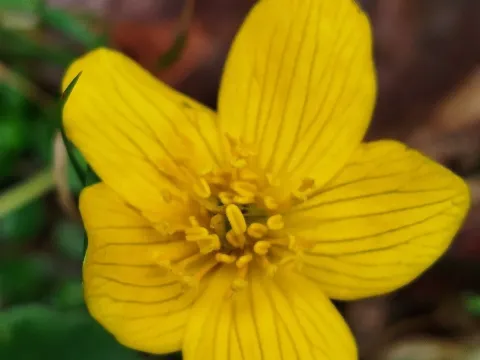
Marsh marigold
Caltha palustris
Marsh marigold (Caltha palustris) is a perennial herbaceous plant belonging to the Ranunculaceae family. It is a highly specialized hydrophyte that thrives in aquatic or semi-aquatic habitats with abundant water supply.
What the section contains
Marsh marigold
Native to temperate regions across the Northern Hemisphere, this plant naturally occurs in marshes, wet meadows, and along the margins of slow-moving streams. Its evolutionary adaptations allow it to persist in soils saturated for most of the growing season.
The culture requires rich, moisture-retentive soils and prefers full sun to partial shade locations. It is exceptionally hardy, capable of enduring cold winters and thriving even in fluctuating water levels of garden ponds or natural water bodies.
Agronomic management is straightforward: planting should occur in areas where the soil remains consistently damp. Propagation is achieved through seed sowing in late summer or by division of mature root clumps in early spring or autumn.
In landscaping, it serves as an excellent marginal plant for water features. While it has historical uses in traditional medicine and cooking (after careful boiling), it is primarily cultivated today for its bright yellow flowers that signal the arrival of spring.
Marsh marigold is generally robust and resistant to most agricultural pathogens; however, excessive humidity without airflow can occasionally facilitate the development of powdery mildew.
Garden pests, particularly slugs and snails, represent the most significant threat to the plant, as they frequently graze on the succulent foliage during moist spring weather.
In some environments, aphids may cluster on the flower stalks or undersides of leaves, causing minor stunted growth if the infestation is heavy enough to weaken the plant.
Management strategies focus on maintaining clean gardening spaces and avoiding the use of synthetic chemicals that could contaminate aquatic ecosystems where the plant is grown.
Regular maintenance, such as trimming back decaying foliage at the end of the season, reduces the risk of fungal buildup and ensures vigorous, healthy growth for the following spring cycle.