
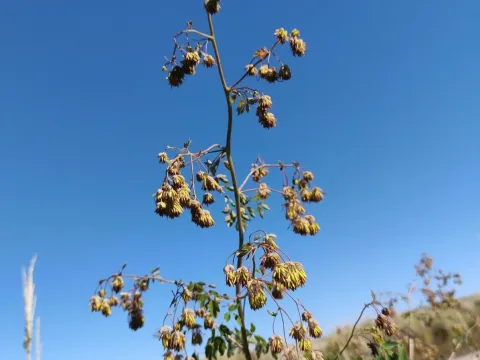
Meadow-rue
Thalictrum L.
Meadow-rue (Thalictrum L.) belongs to the Ranunculaceae family and is a popular perennial plant in horticulture and pharmacological applications.
What the section contains
 Delavay's meadow-rue
Thalictrum delavayi Franch.
Delavay's meadow-rue
Thalictrum delavayi Franch.
 Lesser meadow-rue
Thalictrum minus L.
Lesser meadow-rue
Thalictrum minus L.
 Petal-leaved meadow-rue
Thalictrum petaloideum L.
Petal-leaved meadow-rue
Thalictrum petaloideum L.
 Thalictrum aquilegiifolium
 L.
Thalictrum delavayi
Thalictrum delavayi Franch. x Thalictrum rochebruneanum Franch. & Sav.
Thalictrum aquilegiifolium
Thalictrum aquilegiifolium L.
Thalictrum delavayi
Thalictrum delavayi Franch. x Thalictrum rochebruneanum Franch. & Sav.
 Thalictrum rochebruneanum
 Franch. & Sav.
Thalictrum rochebruneanum
Thalictrum rochebruneanum Franch. & Sav.
 Yellow meadow-rue
Thalictrum flavum L.
Yellow meadow-rue
Thalictrum flavum L.
Meadow-rue
Propagation is generally performed through seed sowing in late autumn, as the seeds require a period of cold stratification to break dormancy.
If sowing in the spring, it is critical to pre-chill seeds in a cold environment for at least two months to ensure uniform germination rates.
Divisions of mature rootstocks are recommended to be performed during the early spring or late summer months to ensure successful establishment of the new plant.
When starting seeds in containers, use a loose, well-draining potting medium and keep it consistently moist but not waterlogged until sprouts appear.
The plant thrives in fertile, moisture-retentive, yet well-drained soils that are rich in organic matter and have a neutral pH.
While most species prefer partial shade, some taller varieties can tolerate full sun provided that soil moisture levels are carefully managed.
Meadow-rue is known for its excellent cold hardiness, making it suitable for temperate regions without the need for intensive winter protection.
Consistent watering is essential during dry spells, particularly in the peak growing season, to prevent wilting and maintain healthy leaf development.
Avoid planting in areas prone to standing water, as the roots are sensitive to waterlogging, which can lead to fungal pathogens.
The economic value of Meadow-rue is derived primarily from its use as medicinal raw material and as a high-quality ornamental garden plant.
The aerial parts of the plant are harvested for their alkaloids, which are processed into specialized herbal supplements and pharmacological preparations.
Harvesting efficiency is maximized by managing plant spacing and ensuring that the soil remains nutrient-dense throughout the growing period.
Dried biomass yield can vary significantly based on local climate and maintenance practices, with healthy plots yielding steady seasonal returns.
The plant is relatively long-lived, and a well-established stand can be harvested for several consecutive years if managed correctly.
Common pests include aphids and various leaf-eating beetles that can damage the delicate foliage and reduce the overall vigor of the plant.
Powdery mildew is a frequent disease issue, especially in environments with poor air circulation or high relative humidity during the summer.
Preventative measures include thinning out plants to improve airflow and monitoring for early signs of fungal infection on leaves and stems.
Integrated pest management, including the use of targeted biological controls, is preferred to maintain the quality of the harvested medicinal material.
Regular sanitation of the growing site, including the removal of dead plant debris, helps minimize the risk of recurring diseases.
Harvesting should be conducted at the height of the flowering period, which is when the active chemical compounds are most concentrated.
Stems are cut using sterilized tools, leaving sufficient growth points at the base to allow for the plant's regeneration in the following season.
Immediate post-harvest processing is required to prevent moisture buildup and potential microbial spoilage of the harvested foliage.
The material should be dried in a controlled environment away from direct sunlight to preserve its color and the integrity of the active ingredients.
Once dried, store the raw material in moisture-resistant, breathable containers to protect it from environmental contaminants and humidity.