
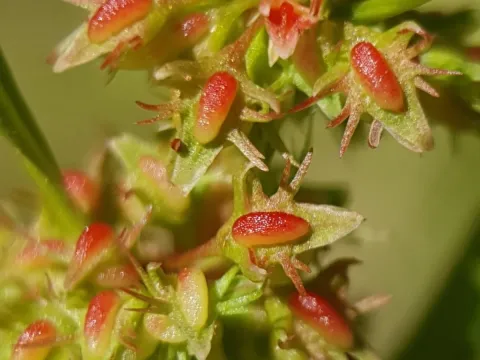
Marsh dock
Rumex palustris
Marsh dock, scientifically known as Rumex palustris, is a member of the Polygonaceae family. It is a moisture-loving species that thrives in damp environments. Sowing typically takes place in early spring once the soil temperature is consistently above 8 degrees Celsius, which is optimal for germination.
What the section contains
Marsh dock
Seeds should be sown at a depth of 1 to 2 centimeters in rows spaced approximately 25 centimeters apart. This spacing allows for sufficient airflow and simplifies weeding processes, which are essential during the early stages of the plant's development.
It is important to ensure that the soil remains moist after sowing. Using a roller to lightly compress the soil surface after planting helps improve the capillary rise of water to the seeds, significantly increasing the uniformity of the emergence.
In regions with milder climates, late autumn sowing is an option, allowing for earlier harvest in the following year. However, if sown late, seeds should be covered slightly deeper to protect them from premature germination during warm winter spells.
Crop rotation should be strictly observed, avoiding planting in fields where other species of the Polygonaceae family have recently been grown. This practice is crucial for reducing the pressure from specific soil-borne pathogens and weeds that typically infest dock crops.
As implied by its name, Rumex palustris requires high moisture levels and is uniquely adapted to wetlands, floodplains, and areas with high water tables. It performs best in fertile, humus-rich soils that retain moisture effectively.
The ideal soil pH for this crop ranges from 5.5 to 6.5. While the plant can tolerate slightly acidic conditions, extreme acidity can hinder root development and reduce overall leaf productivity, necessitating soil amendment with lime if required.
Nitrogen is the most critical nutrient for this crop, as it drives the vegetative growth of the leaves. Applying organic matter such as compost or well-rotted manure before planting helps maintain soil structure and provides a slow-release source of nutrients.
The crop prefers full sun exposure to maximize photosynthetic efficiency, although it demonstrates a remarkable ability to adapt to partial shade. However, plants grown in full sun generally show better color and higher concentrations of beneficial organic acids.
The plant is highly resilient to temporary waterlogging, a trait that sets it apart from many other leafy greens. Despite this, ensuring proper drainage prevents stagnation, which can occasionally lead to root rot during prolonged periods of cool weather.
Yield potential is dependent on regular maintenance and the intensity of the harvesting schedule. In well-managed systems, the crop can provide multiple cuts throughout the growing season, contributing to a high total annual output.
Productivity typically ranges from 20 to 40 tonnes per hectare, depending on soil fertility and moisture management. The key to high yields is the prompt application of balanced fertilizers after every harvest to encourage rapid leaf regrowth.
Managing the flowering cycle is essential; producers must remove flower stalks as soon as they appear. If allowed to develop seeds, the plant redirects energy away from the leaves, resulting in poor quality harvest and decreased overall productivity.
After three to four years, the yield usually declines, and the planting should be rejuvenated. This involves dividing established crowns or, more commonly, clearing the area and reseeding to restore the soil and plant vigor for future cycles.
Regular monitoring of plant health ensures that yields are not compromised by late-season stress. By maintaining a steady supply of moisture and nutrients, farmers can ensure that the leaves remain succulent and free from premature hardening.
The most significant threats to Rumex palustris include fungal diseases such as downy mildew and rust, which thrive in the high-humidity environments that the plant prefers. Promoting air circulation within the canopy is a critical preventive measure.
Pests like the dock leaf beetle can cause extensive damage by feeding on foliage, leaving only the veins intact. Aphids and various species of bugs may also cluster on the undersides of leaves, causing curling and stunted growth if not addressed.
Integrated pest management (IPM) is the best approach. This includes crop rotation, maintaining field hygiene by removing debris, and relying on biological controls such as predatory insects to keep aphid and beetle populations below economic thresholds.
Chemical intervention should be a last resort due to the rapid uptake of chemicals by the leaves, which are intended for human consumption. If pesticides must be used, strict adherence to pre-harvest intervals is mandatory to ensure consumer safety.
Regular soil cultivation between rows helps disrupt the life cycle of soil-dwelling pests and reduces weed competition. A healthy, well-fertilized crop is naturally more resilient to minor pest infestations and disease pressures.
Harvesting is performed when leaves reach the desired size, typically 10 to 15 centimeters. The cutting height is crucial; it must be high enough to avoid damaging the growing point located at the base of the leaf rosette to allow for regrowth.
After the harvest, the product must be chilled immediately. Marsh dock leaves are prone to rapid wilting and oxidation, so processing or cooling to 0–2 degrees Celsius within hours of cutting is vital for maintaining a fresh, market-ready appearance.
Professional harvesting often uses specialized equipment with adjustable blades to ensure a clean cut. Manual harvesting, while more labor-intensive, allows for better selection and quality control, ensuring that only healthy, non-flowering leaves are picked.
The frequency of harvest depends on the growth rate, which is dictated by the temperature and light levels. In the peak of the season, harvests can occur every two weeks, whereas cooler weather may necessitate longer gaps between cuts.
Proper storage involves high humidity (90–95%) and temperatures near freezing to keep the leaves crisp. Packing the product in breathable, ventilated containers prevents mechanical bruising and the onset of decay during the supply chain process.