
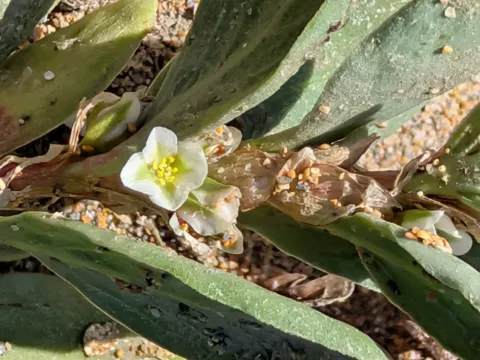
Sea knotgrass
Polygonum maritimum
Sea knotgrass is a perennial herb that propagates naturally through seeds dispersed along coastal sands. In a cultivated or restoration setting, seeds should be sown in early spring once soil temperatures reach 10-12 degrees Celsius, ensuring favorable conditions for germination.
What the section contains
Sea knotgrass
The seeds require a loose, sandy medium and should be planted at a shallow depth of 1-2 centimeters. This prevents them from being buried too deeply while keeping them protected from the drying effects of the sun and wind during the initial germination phase.
Success depends on maintaining adequate soil moisture during the first few weeks after sowing. Since the plant is naturally adapted to beach environments, establishing a strong taproot is essential for its long-term survival, requiring careful irrigation until the plant is fully settled.
In nursery settings, propagating Sea knotgrass in containers is a standard practice to produce robust seedlings. This method ensures high survival rates when transferring plants to dunes, protecting them from erosion and competition with invasive weeds during their establishment phase.
Once the root system is well-developed, the plants exhibit exceptional resilience. Minimal maintenance is required, as the species is genetically programmed to thrive in the nutrient-poor, saline conditions typical of its natural habitat along the shoreline.
As a member of the Polygonaceae family, Sea knotgrass is a classic halophyte, evolutionary adapted to high salinity. It thrives in maritime conditions where salt spray is constant, thanks to thick, leathery leaves covered by a protective waxy cuticle.
The plant requires full sun exposure and does not tolerate shade, which limits its growth and development. It is strictly a coastal species that excels in well-drained, sandy soils, as it cannot survive in heavy, waterlogged, or clay-based environments that suffocate its roots.
Temperature sensitivity is a key factor; Sea knotgrass prefers temperate maritime climates with mild winters. Prolonged exposure to severe freezing temperatures can damage the root system, which is why its natural range is primarily associated with warmer coastal zones.
Nutrient requirements are remarkably low, as the plant extracts minerals from the marine environment. It serves as a natural stabilizer for shifting dunes, anchoring the sand with its deep, robust root system and extensive creeping stems that form dense mats over time.
The species demonstrates incredible tolerance to wind and physical stress. Its morphology allows it to bend and persist in high-energy coastal zones, making it an invaluable tool for dune restoration and the prevention of coastal sand erosion in vulnerable beach regions.
The productivity of Sea knotgrass is not measured in terms of agricultural crop yield but rather by its ground-covering capability and ecological impact. It effectively forms dense colonies that are critical for dune stabilization and sediment retention along the coastline.
Growth rate is influenced by the density of initial planting and the availability of moisture. In optimal conditions, a single individual can develop a sprawling mat of stems, covering up to one square meter within a single growing season if competition is kept to a minimum.
Seed production occurs during the summer months, providing a source for natural dispersal. However, from a management perspective, the primary goal is maintaining the density of the established cover to ensure continuous protection of the substrate against erosion.
Periodic maintenance, such as the removal of dead plant material after the winter season, helps stimulate new growth and keeps the colony healthy. This practice is essential for sustaining the long-term effectiveness of the plant as a natural barrier.
While Sea knotgrass is not used for human consumption or large-scale fodder, its 'yield' in the context of land management is represented by the cumulative hectares of stabilized shoreline. It remains one of the most effective tools for protecting biodiversity in beach ecosystems.
Sea knotgrass is inherently resistant to many common pests and diseases, which is a major advantage for its use in large-scale ecological projects. Its chemical composition, including high levels of tannins, naturally deters most insects and fungal pathogens.
Root rot is the primary physiological threat, usually triggered by improper management of soil drainage. If the substrate becomes too compacted or waterlogged, the roots, which are adapted to high levels of aeration in sand, quickly succumb to fungal decay.
In terms of external threats, human activity is the most significant factor. Beach erosion, trampling by tourists, and unauthorized vehicular traffic on dunes often result in the total destruction of localized populations, preventing the plant from performing its ecological function.
Competition from invasive plant species can be a major hurdle during the establishment of new plantings. Because Sea knotgrass grows slowly at the start, aggressive weeds can easily outcompete it for nutrients and space, necessitating manual weeding in the first year.
While pests are rarely a concern, local herbivores may occasionally browse the young foliage. However, once the plant reaches maturity and develops its tougher, wax-coated leaves, it generally sustains minimal damage from such disturbances, maintaining its integrity throughout the year.