
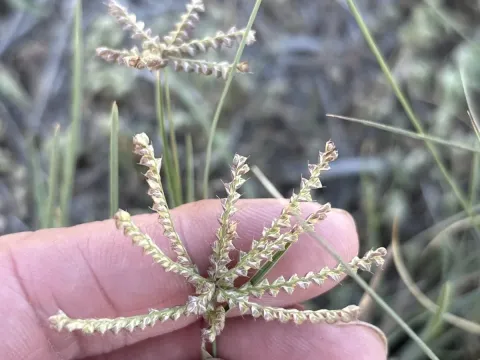
Hooded windmill grass
Chloris cucullata
Hooded windmill grass is a warm-season grass, so the ideal sowing window occurs when soil temperatures are consistently above 15–18 degrees Celsius.
What the section contains
Hooded windmill grass
Spring is the best time for planting, ensuring that the seeds are not exposed to late frost, which can severely impact germination and seedling survival.
In regions with distinct rainy seasons, seeding should coincide with the start of the rains to ensure moisture availability for the establishing root system.
Seeds should be planted at a shallow depth of approximately 1–2 centimeters, ensuring sufficient soil-to-seed contact for uniform emergence across the field.
For range restoration, the grass can be overseeded into existing vegetation, provided there is adequate light and minimal competition during the first weeks.
Hooded windmill grass belongs to the Poaceae family and is highly valued for its ability to thrive in arid conditions and on nutrient-poor sandy soils.
The plant prefers well-lit environments and areas with excellent drainage, as it is highly susceptible to root rot if standing water persists for too long.
Its natural heat and drought tolerance make it an excellent choice for stabilizing soil in environments where more sensitive forage grasses would fail.
It prefers neutral to slightly alkaline soil conditions and is noted for its moderate tolerance to saline environments, expanding its utility in coastal regions.
Consistent management is required to avoid overgrazing, which can degrade the plant base and allow invasive weeds to colonize the pasture space.
The biomass yield of hooded windmill grass is largely determined by nitrogen availability and the total amount of precipitation during the growth cycle.
With proper fertilization and favorable weather conditions, the grass can produce multiple cuts per season, providing a steady supply of nutritious fodder.
Yield metrics vary significantly depending on local climate, soil quality, and the specific intensity of the grazing or mowing schedule implemented.
This grass is a key component in livestock management, offering a high-protein diet that helps support healthy weight gain for cattle and small ruminants.
Maintaining a rotation-based grazing system helps to keep the grass stand productive for many years without the need for frequent re-seeding operations.
Hooded windmill grass is naturally resilient to many common grass diseases, owing to its evolutionary development in diverse and harsh ecological niches.
Potential threats include soil-borne pests such as grubs and larvae, which may attack the roots, especially in younger plants during the initial growth phase.
Excessive humidity and poor drainage can lead to fungal issues and crown rot, which significantly weaken the stand and reduce overall field longevity.
Competition from fast-growing weeds during the establishment period is the most significant hurdle and requires proactive site management and weed control.
- Monitor for signs of pest infestations in early spring.
- Maintain proper drainage to prevent water stagnation.
- Practice clean field management to reduce weed competition.
Harvesting for hay should occur at the early heading stage, as this is when the nutritional value, particularly protein content, is at its peak.
Mowing should be performed at a height of at least 5–7 centimeters to preserve the crown of the plant, ensuring rapid regrowth for future harvests.
It is critical to avoid allowing the grass to become too mature, as the stems become lignified and significantly less palatable to grazing livestock.
Efficient drying processes after mowing are essential to preserve the color and vitamin content of the hay, preventing spoilage from moisture buildup.
Well-timed harvests contribute to the long-term health of the pasture, ensuring that the grass remains a sustainable resource for seasonal feeding needs.