
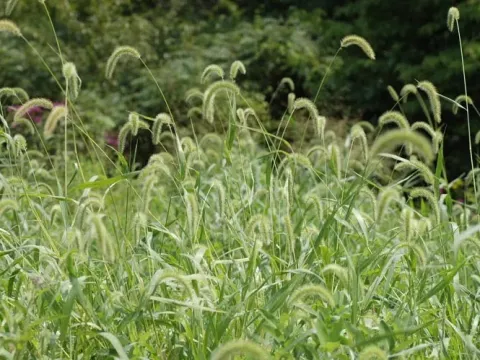
Hybrid foxtail
Setaria hybrids
Sowing of hybrid foxtail should be conducted when the soil temperature at the seeding depth consistently reaches +12...14°C, usually occurring in late spring.
What the section contains
Hybrid foxtail
Ensuring adequate moisture in the topsoil layer during sowing is critical, as dry conditions may significantly reduce emergence rates and lead to uneven plant development.
The seeds of this crop are small; therefore, they must be planted at a shallow depth of 2–3 cm to facilitate rapid germination and strong early root establishment.
The recommended seeding rate is approximately 12–15 kg/ha for green fodder production, while a lower rate of 8–10 kg/ha is used for seed production to favor stronger stems.
Standard row planting with a 15 cm spacing is typically used, allowing the plants to close the canopy quickly, which naturally suppresses weed growth early in the season.
Hybrid foxtail belongs to the Poaceae family and is highly valued as a productive annual forage crop, demonstrating strong adaptation to diverse climatic zones.
The crop is recognized for its high drought tolerance and heat resistance, making it an excellent choice for regions with limited rainfall or volatile weather patterns.
It prefers fertile, well-drained soils, specifically sandy loams or loamy chernozems with a neutral to slightly acidic pH, avoiding areas prone to waterlogging.
As a light-demanding crop, hybrid foxtail requires full exposure to sunlight; competition from weeds must be minimized to ensure the plants reach their full potential.
Successful cultivation relies on proper crop rotation; it is best planted after legumes, which help replenish nitrogen levels in the soil for the following season.
Under optimal management and environmental conditions, hybrid foxtail can produce a green mass yield ranging from 250 to 400 quintals per hectare.
When harvested for hay or silage, the crop typically yields between 60 and 90 quintals of dry matter per hectare, offering high-quality fiber for livestock.
Seed production yields average 15–20 quintals per hectare, allowing farmers to maintain a sustainable supply of seeds for subsequent growing seasons.
The application of nitrogen fertilizers during the tillering phase significantly boosts biomass output, often increasing yields by 20–30% in high-fertility scenarios.
Actual yields are heavily dependent on rainfall during the most sensitive growth phases, specifically during stem elongation and early panicle emergence.
The crop is primarily susceptible to various types of smut, which can cause significant damage to the inflorescences and reduce both seed viability and overall forage quality.
Cereal rust can affect the leaves during periods of high humidity, potentially hindering the plant's photosynthetic efficiency and resulting in lower biomass production.
Insect pests, such as cereal flies and stalk borers, pose a risk during the early developmental stages by damaging the primary stems and stunting plant growth.
Seed treatment with professional fungicides is an essential preventative measure to protect the crop from soil-borne pathogens and seed-transmitted diseases.
Integrated pest management, including regular weeding and maintaining proper distance from other cereal crops, is vital to prevent major outbreaks of common agricultural pests.
Harvesting for green fodder is best performed from the stem elongation phase through early panicle emergence, when the plant's nutritional profile is at its peak.
For hay production, mowing should take place before the seeds fully mature to prevent the stems from becoming too lignified and unpalatable for livestock consumption.
Seed harvest is conducted once the panicles have reached full maturity, often using a combine harvester; the crop can also be swathed first to ensure even drying.
Proper combine adjustment is essential due to the small size of the seeds, ensuring that drum speed and fan settings are calibrated to prevent mechanical damage or loss.
Post-harvest processing includes cleaning and drying the seeds to a moisture level of 12–14%, which is crucial for maintaining germination quality during long-term storage.