
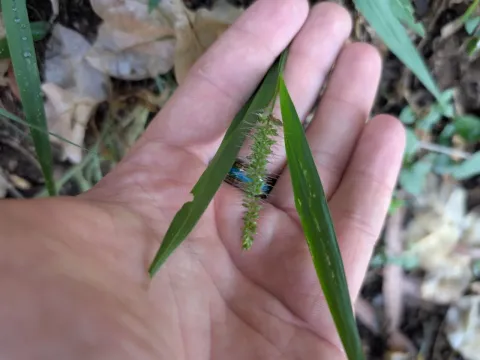
Sticky bristlegrass
Setaria adhaerens
Sticky bristlegrass (Setaria adhaerens) is an annual grass species belonging to the Poaceae family. It is widely recognized as a problematic weed in agricultural landscapes, known for its distinct inflorescence which is densely covered in sticky, hooked bristles.
What the section contains
Sticky bristlegrass
This plant thrives in warm, temperate to tropical climates, preferring well-drained, nutrient-rich soils. Its germination process is highly dependent on soil temperature, with peak emergence occurring during late spring and summer months when the ground is sufficiently warmed.
Botanically, Setaria adhaerens is characterized by a spike-like panicle. The bristles have small, downward-pointing barbs that act as hooks, allowing the seeds to cling to various surfaces, including animal fur and human clothing, facilitating efficient dispersal.
Regarding agronomic requirements, the species is highly competitive for resources such as nitrogen and water. Optimal management involves strategic tillage to disturb seed germination sites and the implementation of competitive crop densities to shade the soil surface.
Historically and economically, this grass is generally viewed as an agricultural nuisance rather than a crop. While it can serve as a supplemental forage source in some pasture systems, its abrasive nature when mature makes it unsuitable for feeding livestock in the later stages of growth.
The primary agricultural threat posed by sticky bristlegrass is its ability to reduce crop yields through severe nutrient and water competition. It establishes rapidly and can quickly outgrow sensitive crop seedlings if not adequately managed.
The plant acts as an alternative host for several economically significant plant pathogens and pests, including various viruses that affect cereals. By maintaining a reservoir of these diseases, the weed complicates the phytosanitary management of a field.
Control is challenging due to the massive seed production of each individual plant and the longevity of seeds in the soil seed bank. Mechanical control methods like shallow cultivation can sometimes stimulate further germination rather than suppress it.
Chemical control programs often involve the use of selective herbicides applied at the early growth stage. Because of the plant's rapid development, timing is critical to ensure that the herbicide application hits the weed before it reaches the tiller stage.
Although subject to grazing by certain insects, Setaria adhaerens remains highly resilient. It lacks major natural enemies that could significantly curb its population, making integrated weed management the most effective approach for farmers.