
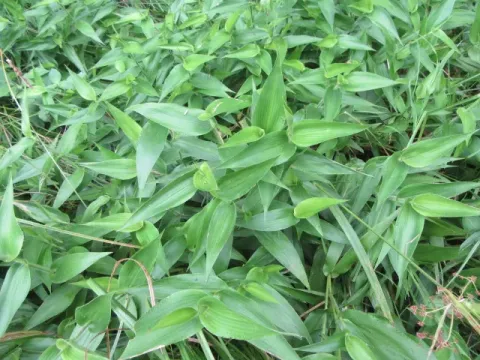
Deertongue grass
Panicum clandestinum
Deertongue grass should be sown in the spring once soil temperatures have reached at least 10–12°C, ensuring optimal conditions for seedling establishment.
What the section contains
Deertongue grass
In regions with milder climates, late autumn seeding can be beneficial, allowing the seeds to benefit from early spring moisture as soon as the frost thaws.
The seeds should be planted at a shallow depth of 1.5 to 2 cm to provide the necessary contact with moist soil while preventing the depth from hindering germination.
Seeding rates typically range from 12 to 15 kg per hectare, depending on the desired plant density and the expected competition from weeds in the establishment phase.
Post-sowing rolling is highly recommended to improve soil-to-seed contact, which effectively increases the rate of germination and promotes more uniform stand development.
Deertongue grass (Panicum clandestinum) is a perennial member of the Poaceae family, native to North America, known for its adaptability to various soil types.
Botanically, it is distinctive for its cleistogamous flowers hidden within the leaf sheaths, a trait that gives the plant its name and ensures reproductive success.
This crop prefers moist, fertile sites, including floodplains and forest margins, and it shows a notable ability to thrive in partial shade conditions where other grasses fail.
The soil should have good structure and organic content; while the plant is robust, it does not perform well in waterlogged areas with stagnant soil oxygen levels.
Climatic requirements involve moderate rainfall throughout the growing season, although the plant has developed survival mechanisms to cope with temporary dry spells.
While generally resistant to most common agricultural pests, Deertongue grass can be vulnerable to cereal flies, which may damage emerging stems in early stages.
Fungal diseases, specifically rusts and leaf spots, may occur during periods of high humidity and poor air circulation, particularly in dense, ungrazed stands.
Nematode infestations can occasionally affect the root systems if the crop is grown in the same field for many consecutive years without crop rotation.
Effective management strategies include maintaining appropriate stocking rates for grazing and ensuring that the grass is not allowed to become overly thick and humid.
Monitoring the fields for signs of wilting or discoloration is essential for early detection of pathogen pressure and implementing necessary cultural control measures.
Deertongue grass is primarily utilized as a high-quality forage crop, providing significant biomass for both grazing livestock and mechanical harvesting.
For optimal nutritional quality, harvesting should occur during the heading stage, when the protein content is at its peak and the fiber content is still manageable.
When producing hay, it is vital to dry the cut material efficiently to a moisture content below 17% to ensure safe storage and prevent the development of harmful molds.
Seed harvesting requires precise timing, as the seeds have a tendency to shatter when fully mature; thus, harvesting should begin as soon as the first seeds begin to ripen.
Proper harvest management involves avoiding overgrazing to ensure that the plant maintains sufficient energy reserves in its rhizomes for overwintering and rapid spring regrowth.