
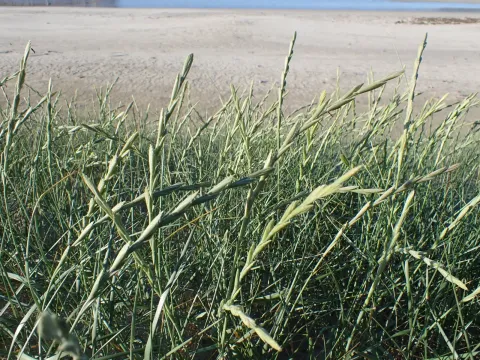
Sea couch grass
Elymus farctus
Sowing of sea couch grass is best performed in the autumn or early spring to utilize natural soil moisture levels. Seeds require a period of stratification, which is naturally provided by winter conditions in their native coastal habitats.
What the section contains
Sea couch grass
The seeds should be sown at a depth of 2–3 centimeters in sandy soils. In dune stabilization projects, it is critical to ensure seeds are lightly covered to prevent wind erosion from displacing them before germination.
Seeding rates vary depending on the objective, with higher densities used for rapid ground coverage. The species has high germination vigor, allowing it to quickly occupy and stabilize shifting sandy substrates.
Vegetative propagation using rhizome segments is considered the most reliable method for establishing populations in areas prone to severe wind or water erosion. This method ensures faster establishment compared to direct seeding.
Maintenance during the initial establishment phase involves monitoring for invasive species, though once established, sea couch grass is a highly competitive plant that excludes most other weed species in its environment.
Sea couch grass belongs to the Poaceae family and is a specialized halophyte adapted to high soil salinity. It is a common feature of coastal landscapes across Europe and the Mediterranean basin.
The plant is extremely undemanding regarding soil fertility and thrives in poor, sandy, or rocky conditions. It exhibits high drought tolerance, although consistent access to soil moisture significantly improves its growth rates.
The ideal climate for this grass is maritime, characterized by mild temperatures and limited frost. However, the species possesses significant cold tolerance, allowing it to survive in regions with harsh winter conditions.
A key biological trait is its high tolerance to periodic saltwater inundation and salt spray, which makes it an indispensable component of coastal protection and habitat restoration programs.
- Exceptional salt tolerance for coastal environments.
- Resistance to wind-driven sand abrasion.
- Deep and spreading rhizome system.
- Ability to thrive in low-nutrient substrates.
- High photophilous demand for full sunlight exposure.
In agricultural and environmental management, yield is defined by the plant's ability to produce biomass for soil stabilization and dune reinforcement rather than fodder production. Biomass accumulation is steady and increases over time.
The effectiveness of the planting peaks by the third year, when the underground rhizome network creates a solid mat that prevents sand movement. Initial years are characterized by slower above-ground biomass growth.
Growth performance is closely linked to salt levels and nutrient availability, though the species maintains high viability even under very poor environmental conditions that would kill most other plants.
While the plant can withstand moderate grazing, it is primarily used as a pioneer species for stabilization. Overgrazing must be managed to prevent damage to the soil-binding rhizome structure.
While fertilization can increase biomass, it is rarely employed in restoration projects to ensure that the plants remain adapted to the natural, nutrient-poor conditions of their coastal habitat.
Sea couch grass possesses high natural resistance to common crop diseases. Its halophytic nature and the saline environment it occupies significantly inhibit the development of most fungal pathogens.
Pests that typically affect grain crops show little interest in sea couch grass due to the high silica content and tough texture of its leaves. This makes it an ideal candidate for low-input ecological restoration.
The primary threat to established stands is human-induced mechanical damage, such as foot traffic in recreational areas or the operation of heavy machinery, which can break the fragile surface crust.
Competition from invasive species can sometimes occur, but the aggressive spread of sea couch grass rhizomes usually allows it to maintain dominance in its natural coastal niche.
Soil-borne pests may pose a minor threat in areas with low salt concentrations, but in typical coastal dune conditions, the population of such pests is naturally suppressed by the extreme environment.