


Reference · Crops
Wheatgrass
Elymus L.
The planting of wheatgrass is usually carried out in the spring months when soil temperatures have reached at least 5-8 degrees Celsius to trigger germination.
14
items
What the section contains
 Canada wildrye
Elymus canadensis L.
Canada wildrye
Elymus canadensis L.
 Couch grass
Elymus repens (L.) Gould
Couch grass
Elymus repens (L.) Gould subsp. repens
Couch grass
Elymus repens (L.) Gould
Couch grass
Elymus repens (L.) Gould subsp. repens
 Dahurian wildrye
Elymus dahuricus Turcz. ex Griseb. Nevski
Dahurian wildrye
Elymus dahuricus Turcz. ex Griseb. Nevski
 Giant lyme grass
Leymus racemosus (Lam.) Tzvelev subsp. Racemosus
Giant lyme grass
Leymus racemosus (Lam.) Tzvelev subsp. Racemosus
 Hoffmann's wheatgrass
Elymus hoffmannii K. B. Jensen & K. H. Asay
Hoffmann's wheatgrass
Elymus hoffmannii K. B. Jensen & K. H. Asay
 Northern wheatgrass
Elymus lanceolatus (Scribn. & J. G. Sm.) Gould subsp. lanceolatus
Short-awned wheatgrass
Elymus breviaristatus (Hitchc.) Á. Löve
Short-awned wheatgrass
Elymus breviaristatus (Hitchc.) Á. Löve subsp. scabrifolius (Döll) Á. Löve
Northern wheatgrass
Elymus lanceolatus (Scribn. & J. G. Sm.) Gould subsp. lanceolatus
Short-awned wheatgrass
Elymus breviaristatus (Hitchc.) Á. Löve
Short-awned wheatgrass
Elymus breviaristatus (Hitchc.) Á. Löve subsp. scabrifolius (Döll) Á. Löve
 Siberian wildrye
Elymus sibiricus L.
Siberian wildrye
Elymus sibiricus L.
 Slender wheatgrass
Elymus trachycaulus (Link) Gould ex Shinners
Slender wheatgrass
Elymus trachycaulus (Link) Gould ex Shinners
 Slender wheatgrass
Elymus trachycaulus (Link) Gould ex Shinners subsp. subsecundus (Link) Á. Löve & D. Löve
Slender wheatgrass
Elymus trachycaulus (Link) Gould ex Shinners subsp. subsecundus (Link) Á. Löve & D. Löve
 Slender wheatgrass
Elymus trachycaulus (Link) Gould subsp. trachycaulus
Slender wheatgrass
Elymus trachycaulus (Link) Gould subsp. trachycaulus
 Thickspike wheatgrass
Elymus lanceolatus (Scribn. & J. G. Sm.) Gould
Thickspike wheatgrass
Elymus lanceolatus (Scribn. & J. G. Sm.) Gould
Marketplace
Products in this section · 12
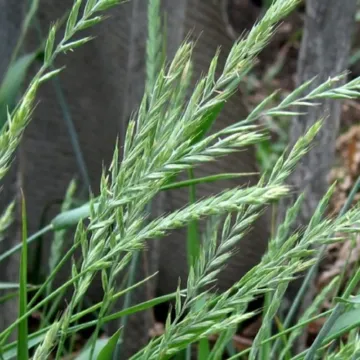


Wheatgrass
Late autumn sowing is also a viable option in many regions, allowing the seeds to undergo natural stratification, which often results in more uniform spring emergence.
Seeding rates are typically set between 10 to 15 kilograms per hectare, depending on the desired density and whether the crop is intended for hay or grazing.
Seeds should be sown at a shallow depth of 2 to 3 centimeters, followed by mechanical rolling to ensure good soil-to-seed contact for better moisture uptake.
Proper field preparation, including the removal of competing weeds, is essential before planting to provide the seedlings with sufficient space and resources.
Wheatgrass belongs to the Poaceae family and is known for its incredible resilience, adapting well to a wide range of climatic conditions across various zones.
The crop is highly drought-tolerant, possessing an extensive root system that allows it to access water deep within the soil profile during dry spells.
Wheatgrass is not particularly demanding regarding soil types; it thrives in loamy soils but can also adapt to sandy or even mildly saline conditions.
Exposure to sunlight is critical for the healthy development of this grass, so it should be planted in open areas away from heavy forest shade.
Its winter hardiness is a major advantage, enabling it to survive severe frost and sudden temperature drops in regions with harsh continental climates.
Yield potential of wheatgrass is largely determined by soil fertility levels and the frequency of fertilizer application during the active growing season.
In well-managed hay fields, producers can expect yields ranging from 3 to 5 tons of dry hay per hectare from one or two harvesting cycles.
For grazing purposes, the biomass production is significant, providing a steady supply of nutritious feed that supports livestock throughout the year.
Consistent nitrogen application in early spring is recommended to boost leaf growth and ensure high-quality biomass production for forage needs.
The stands generally remain highly productive for about four years, after which a renewal of the field is necessary to maintain optimum output.
While wheatgrass is generally robust, it can be susceptible to fungal diseases like rust and powdery mildew when humidity levels remain high for extended periods.
Insect pests, such as aphids and various types of flies, may target the vegetative parts of the plant, potentially affecting overall growth rates.
Integrated pest management strategies should be employed, focusing on cultural practices before resorting to chemical interventions like fungicides or insecticides.
Monitoring the fields regularly allows for the early detection of issues, which is crucial for preventing significant economic losses in the crop.
- Use of disease-resistant varieties.
- Proper irrigation management.
- Removal of infected crop residue.
- Maintaining healthy soil fertility.
Harvesting for high-quality hay must occur during the boot stage or the very beginning of the heading phase to maximize protein and nutrient content.
When producing seeds, the harvest should be delayed until full maturity to ensure seed viability, using precise combine settings to prevent shattering.
Efficiency in the harvest process is achieved by using professional swathers and balers that minimize leaf loss during the drying and collection stages.
Drying the forage to an appropriate moisture level is vital for safe storage, preventing mold growth and preserving the nutritional value of the harvest.
Properly harvested wheatgrass provides excellent forage that remains palatable and nutritious for livestock through the winter and storage periods.