

Reference · Crops
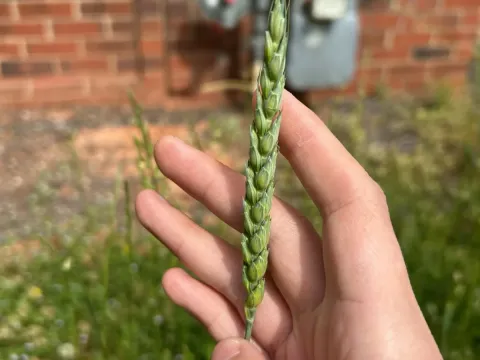
Wheat
Triticum L.
The sowing period for wheat depends on the variety and the specific climatic zone. Winter wheat is typically planted in the autumn, allowing the plants to establish roots before the winter dormancy.
17
items
What the section contains
 Winter wheat
Triticum aestivum L.
2 975 products
Winter wheat
Triticum aestivum L.
2 975 products
 Club wheat
Triticum aestivum L. subsp. compactum (Host) Mackey
Dense wheat
Triticum aestivum x T. turgidum L.
Club wheat
Triticum aestivum L. subsp. compactum (Host) Mackey
Dense wheat
Triticum aestivum x T. turgidum L.
 Durum wheat
Triticum durum Desf.
Durum wheat
Triticum durum Desf.
 Durum wheat
Triticum turgidum L.
Durum wheat
Triticum turgidum L.
 Durum wheat
Triticum turgidum L. subsp. dicoccum (Schrank ex Schübl.) Thell. x Triticum durum Desf.
Durum wheat
Triticum turgidum L. subsp. dicoccum (Schrank ex Schübl.) Thell. x Triticum durum Desf.
 Durum wheat
Triticum turgidum L. subsp. turgidum
Durum wheat
Triticum turgidum L. subsp. turgidum
 Einkorn
Triticum monococcum L.
Indian dwarf wheat
Triticum aestivum L. subsp. sphaerococcum (Percival) Mackey
Einkorn
Triticum monococcum L.
Indian dwarf wheat
Triticum aestivum L. subsp. sphaerococcum (Percival) Mackey
 Khorasan wheat
Triticum turgidum L. subsp. turanicum (Jakubz.) Á. Löve & D. Löve
Khorasan wheat
Triticum turgidum L. subsp. turanicum (Jakubz.) Á. Löve & D. Löve
 Persian wheat
Triticum turgidum L. subsp. carthlicum (Nevski) Á. Löve & D. Löve
Persian wheat
Triticum turgidum L. subsp. carthlicum (Nevski) Á. Löve & D. Löve
 Polish wheat
Triticum turgidum L. subsp. polonicum (L.) Thell.
Polish wheat
Triticum turgidum L. subsp. polonicum (L.) Thell.
 Soft wheat
Triticum aestivum L. subsp. aestivum
Spelt
Triticum aestivum subsp. aestivum x Triticum aestivum subsp. spelta
Soft wheat
Triticum aestivum L. subsp. aestivum
Spelt
Triticum aestivum subsp. aestivum x Triticum aestivum subsp. spelta
 Spelt
Triticum aestivum L. subsp. spelta (L.) Thell. x T. turgidum L. subsp. dicoccon (Schrank) Thell.
Spelt
Triticum aestivum L. subsp. spelta (L.) Thell. x T. turgidum L. subsp. dicoccon (Schrank) Thell.
 Spelt
Triticum turgidum L. subsp. dicoccum (Schrank ex Schübl.) Thell.
Spelt
Triticum turgidum L. subsp. dicoccum (Schrank ex Schübl.) Thell.
 Spelt wheat
Triticum aestivum L. subsp. spelta (L.) Thell.
Spelt wheat
Triticum aestivum L. subsp. spelta (L.) Thell.
Marketplace
Products in this section · 12


Биоорганическое нано удобрение "НАГРО" / "NAGRO"
LLC NPO "BIOPLAN"
Fertilizers
43
25
1 offer
37.63 €за л
Buy


Wheat
Spring wheat is sown as early as possible in the spring, once the soil has warmed up and is dry enough for field machinery. Early sowing ensures better utilization of soil moisture.
The planting depth is generally set between 3 to 5 cm. Correct depth is crucial for uniform germination and establishing a strong foundation for the crop's development.
Seeding rates are calculated based on soil quality, germination percentage, and local agronomic practices. High-density planting can increase competition, so optimization is key.
Seed treatment is a standard practice to protect the young seedlings from soil-borne pathogens and insects, ensuring a healthy start for the crop throughout its early growth stages.
Wheat, belonging to the Poaceae family, thrives in well-drained, fertile soils like loams and chernozems. It requires a balanced supply of essential nutrients for optimal growth.
Moisture management is vital, particularly during the stem elongation and heading stages. Stress during these periods can significantly reduce grain filling and final yield.
Temperature plays a crucial role in plant metabolism. While wheat is a cool-season crop, it requires sufficient warmth for rapid biomass accumulation during the vegetative phase.
Fertilization programs must be based on soil testing data. Nitrogen application is often split to ensure availability during key growth stages, while phosphorus and potassium support root strength.
Wheat is a long-day plant, meaning its flowering and maturation are regulated by the duration of sunlight, which should be considered when choosing varieties for specific latitudes.
Yield potential is driven by genetic capacity, effective weed control, and optimal nutrient management. Under high-input farming, wheat can produce substantial grain volumes.
The crop relies on efficient photosynthesis in the flag leaf to fill the grain. Protecting this leaf from diseases and pests is essential to achieve high thousand-grain weight.
Crop rotation is a fundamental practice in wheat farming. Planting wheat after legumes or fallow can significantly improve soil structure and reduce the pathogen load in the field.
Adequate stem density is established during the tillering phase. Agronomic interventions, including growth regulators, help manage canopy development and prevent lodging in dense crops.
Monitoring for nutrient deficiencies during the season allows for timely foliar applications, which can provide the microelements necessary for grain development and protein synthesis.
Common wheat diseases include powdery mildew, leaf rust, and fusarium head blight. These pathogens thrive in humid conditions and can cause severe damage if left unmanaged.
Pests such as aphids, cereal leaf beetles, and Hessian flies pose significant threats to the crop. Regular scouting is required to identify outbreaks before they reach economic damage levels.
Integrated Pest Management (IPM) is the most effective approach, combining biological controls with selective chemical applications to minimize environmental impact while protecting yields.
Fungicide applications are often scheduled preventatively, especially in high-humidity environments where disease pressure is consistently high throughout the growing season.
- Powdery Mildew
- Leaf Rust
- Cereal Aphids
- Hessian Fly
Harvesting takes place when the grain reaches maturity and moisture content drops to a safe level, typically around 14%. Proper timing is critical to prevent grain loss and spoilage.
Modern combine harvesters are optimized for efficiency, reducing grain damage and losses during the threshing and separation processes in the field.
Post-harvest management involves cleaning and drying the grain to prevent mold development during storage. Proper aeration in silos maintains the quality of the harvested produce.
Quality grading is performed after harvest to assess protein content and test weight, which determine the market price and the final end-use of the wheat crop.
Logistical planning during the harvest season ensures that wheat is transported and stored efficiently, protecting the farmer's investment against weather-related quality degradation.