
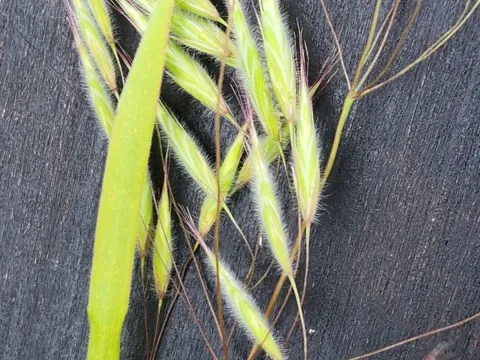
Pectinate brome
Bromus pectinatus
Pectinate brome is typically sown in early spring when soil conditions are ideal for germination. In regions with milder climates, late autumn sowing is also practiced to allow the seeds to benefit from winter moisture.
What the section contains
Pectinate brome
Seeds should be sown at a depth of 1.5 to 3 cm. On sandy or lighter soils, deeper sowing is recommended to ensure adequate moisture contact, while in heavy clay soils, shallower planting is preferred to facilitate seedling emergence.
The seeding rate ranges between 12–16 kg per hectare depending on the seed viability and the intended density of the stand. Proper calibration of seeding equipment is essential to achieve a uniform distribution.
Post-sowing rolling is a critical practice for this species. Firming the soil surface ensures better capillary action, which is vital for the establishment of small grass seeds in variable weather conditions.
The seedbed must be well-prepared, free from perennial weeds, and adequately fertilized. Good weed control prior to sowing significantly improves the success rate of the established grass stand.
As a member of the Poaceae family, Pectinate brome is a versatile perennial grass. It thrives in various environments, exhibiting significant resilience to temperature fluctuations and moderate drought stress.
The species performs best on fertile, well-drained loamy or chernozem soils. While it is adaptable to different soil types, it performs poorly in waterlogged areas where root aeration is restricted.
Pectinate brome has moderate climatic requirements, being well-suited for temperate and continental climates. Its strong root system allows it to access water and nutrients effectively during the growing season.
Fertilization management is key to productivity. Nitrogen applications in early spring promote vigorous regrowth, while phosphorus and potassium are essential for long-term stand persistence and winter survival.
The crop requires full exposure to sunlight. Shading from competing vegetation should be avoided, as it can significantly reduce tillering and overall dry matter production during the establishment phase.
Yield potential is highly dependent on site fertility and management intensity. Under optimal conditions, this grass can produce multiple cuts annually, making it a reliable source of quality forage.
Dry matter yields typically range from 4 to 7 tonnes per hectare. With proper irrigation and consistent fertilization, these figures can be significantly improved, supporting high livestock carrying capacity.
The nutritional profile of Pectinate brome, including protein content and palatability, remains high until the late flowering stages. This provides flexibility for harvesting, allowing producers to optimize yield vs. quality.
Regrowth capacity is a notable trait of this species. After mowing or grazing, the plants recover quickly, provided that adequate soil moisture is maintained throughout the summer period.
Seed production requires specific management. Yields of 300–500 kg per hectare are achievable if the crop is harvested at physiological maturity before significant seed shattering occurs in the field.
Common diseases affecting Pectinate brome include various rusts and powdery mildew. These are more prevalent in humid environments with poor air circulation, necessitating proper canopy management.
Insect pests, such as aphids, can cause significant damage if populations are not monitored. Integrated pest management practices should be used, emphasizing prevention and biological controls where possible.
Weed competition is particularly detrimental during the first year. The use of selective herbicides or early mowing can prevent weeds from overwhelming the slow-establishing grass seedlings.
Soil-borne pathogens and nematodes can affect long-term persistence on degraded soils. Implementing a diverse crop rotation is a highly effective way to break pathogen cycles and improve soil health.
Overgrazing poses a major threat to stand longevity. Maintaining the recommended residual height after grazing is essential to ensure that the plants have enough energy reserves for regrowth.
For high-quality hay, harvesting should occur at the early heading or beginning of the flowering stage. This timing captures the ideal balance of energy and protein content required for livestock.
Rapid drying of the cut grass is crucial for preserving quality. Using modern tedders helps accelerate moisture loss, preventing nutrient leaching and mould development in the bale.
Rotational grazing systems are recommended for Pectinate brome to maintain stand vigor. This approach allows the plants to rest and recover, promoting a dense and productive pasture.
Seed harvesting is best conducted via direct combining when the seeds are mature. Careful adjustment of combine settings is necessary to minimize seed loss and ensure the purity of the harvested grain.
Post-harvest storage should involve cooling and active ventilation to prevent heating. Keeping the stored hay or seeds dry and protected from rodents is essential to maintain feed value and seed viability.