
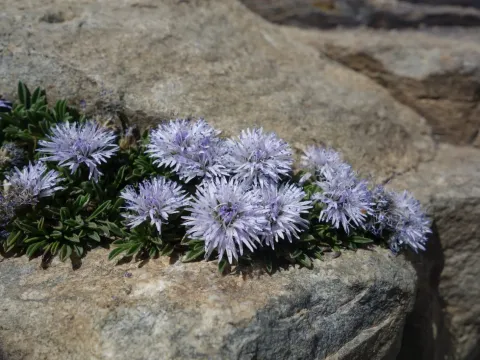
Globularia repens
Globularia repens
Globularia repens, commonly known as a type of globe daisy, is a low-growing perennial herbaceous plant belonging to the Plantaginaceae family. Naturally, it inhabits the mountainous regions of Southern Europe, thriving specifically in rocky outcrops and crevices where competition from larger plants is minimal.
What the section contains
Globularia repens
Botanically, it is characterized as an evergreen subshrub that forms dense, mat-forming carpets reaching heights of only 5 to 10 centimeters. The leaves are small, leathery, and arranged in tight rosettes, which serves as an adaptation to minimize transpiration in high-altitude environments.
Successful cultivation requires highly specific conditions, primarily well-drained, nutrient-poor, alkaline, or neutral soils. The plant is extremely susceptible to root rot caused by stagnant water, making the inclusion of coarse gravel or sand in the soil medium essential for effective drainage.
Globularia repens is a heliophilous species, meaning it requires full exposure to sunlight to maintain its compact growth form. When planted in shaded or poorly lit areas, the stems tend to stretch, resulting in sparse, weak mats and a significant reduction in the intensity of its floral display.
Regarding agricultural practices, the plant exhibits notable cold hardiness; however, it requires protection from desiccating winter winds in exposed locations. Maintenance activities focus on ensuring the soil moisture remains moderate, as the plant prefers conditions that are neither waterlogged nor severely dehydrated.
The primary threats to this species are fungal diseases, which are exacerbated by excessive atmospheric humidity and improper air circulation around the mats. Root pathogens can rapidly destroy entire colonies if the drainage system fails to prevent moisture accumulation around the base of the plant.
While the leathery foliage provides some resistance to common pests, spider mites can occasionally become a concern during prolonged periods of drought and high heat. These pests sap the vitality of the plant, potentially leading to stunted growth or increased vulnerability to secondary infections.
The economic value of Globularia repens is almost exclusively restricted to the ornamental horticulture industry, where it is favored for alpine gardens and rockeries. There is no commercial harvesting cycle, but regular maintenance, including the removal of spent flower heads, is recommended to encourage vegetative health and maintain the desired aesthetic of the planting.