
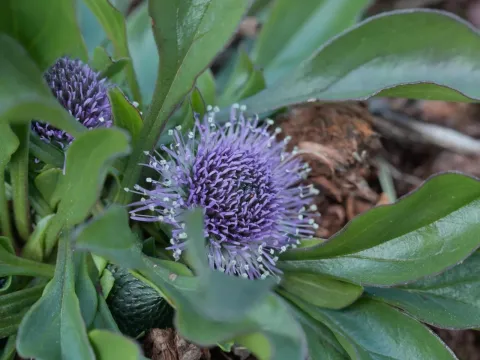
Common globularia
Globularia punctata
The common globularia (Globularia punctata) is a perennial herb belonging to the Plantaginaceae family. Naturally, it occurs in Central and Southern Europe, thriving in limestone-rich habitats and dry, rocky slopes.
What the section contains
Common globularia
This plant is highly valued for its extreme drought tolerance and winter hardiness. For optimal growth, it requires full sun exposure and cannot tolerate shaded areas, as lack of light leads to poor flowering and structural weakness of the foliage rosettes.
Soil composition is critical for this species. It demands well-drained, alkaline or calcareous, and stony soils. Any waterlogging will almost inevitably lead to the death of the root system, making proper site preparation essential.
Botanically, it forms dense, low-growing mounds of dark green, leathery leaves. The unique, spherical blue-to-violet inflorescences appear in early summer, making it an excellent choice for rock gardens, crevice plantings, and dry borders.
Regarding its utility, the species is widely used as a ground cover in xeriscaping projects. It requires minimal intervention, as it is perfectly adapted to nutrient-poor soils and rarely needs supplemental fertilization.
The most significant threat to Globularia punctata is excessive soil moisture. This leads to fungal pathogens attacking the crown and roots. Providing a thick layer of mineral mulch or grit ensures that moisture drains away from the foliage.
During humid spells, the plant may occasionally suffer from powdery mildew. Removing dead foliage and ensuring excellent air circulation around the plants is the primary method of preventing the spread of these pathogens.
In garden settings, slugs and snails can feed on the leaves during spring. Creating a sharp border of crushed gravel or limestone chippings around the plants can effectively deter these mollusks from reaching the foliage.
Soil-dwelling pests like grubs can occasionally damage the roots of established plants. However, in healthy, well-drained mineral soils, these occurrences are generally sporadic and rarely cause widespread damage.
Overall, maintaining healthy plants is achieved through selective site choice rather than chemical control. The species is robust and disease-resistant when planted in conditions that mimic its natural dry, Mediterranean-style habitat.