
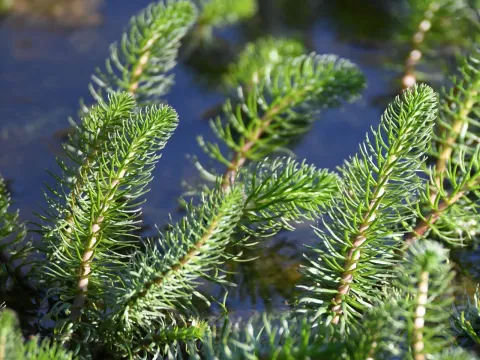
Common mare's tail
Hippuris
Common mare's tail (Hippuris vulgaris) is a perennial aquatic plant belonging to the Plantaginaceae family. It is a highly specialized hydrophyte that thrives in shallow waters and wetland habitats across the temperate and cold regions of the Northern Hemisphere.
What the section contains


Common mare's tail
The plant is native to a vast range of environments, being particularly common in Eurasia and North America. It typically grows in nutrient-rich muddy substrates and requires consistent saturation, being a characteristic species of stable wetland ecosystems and shallow ponds.
Botanically, Hippuris vulgaris is defined by its erect, unbranched stems that emerge from submerged rhizomes. The leaves are arranged in distinctive whorls around the stem, providing the plant with a unique, brush-like appearance that allows it to survive in both submerged and emergent conditions.
For cultivation purposes, common mare's tail demands water-logged conditions and high availability of aquatic nutrients. It prefers full sun to partial shade and is highly tolerant of various pH levels, provided the water remains relatively still or slow-moving.
In agricultural and environmental engineering, this plant is primarily utilized for phytoremediation. Its ability to absorb excess nitrogen and phosphorus from water makes it an ideal candidate for constructed wetlands and bio-filtration systems designed to treat agricultural runoff.
While the common mare's tail is generally robust, it can be susceptible to fungal infections if the water quality deteriorates or if there is insufficient circulation in densely packed planting zones.
Several aquatic insect species can act as pests, primarily those that graze on the emergent green tissues. These pests can weaken the plant's structural integrity, although the plant typically recovers well during the next growth cycle.
Competition from invasive tall grasses and reeds poses the most significant threat to the survival of mare's tail colonies. Without proper management and thinning, more aggressive aquatic flora can easily shade out and displace this species.
To maintain healthy stands, it is necessary to manage the ecosystem to prevent excessive buildup of sludge, which can harbour pathogens and promote root rot if oxygen levels drop significantly.
Integrated management plans, including periodic sediment monitoring and selective clearing, are the recommended strategies to ensure the long-term health and functional efficiency of Hippuris vulgaris plantations.