
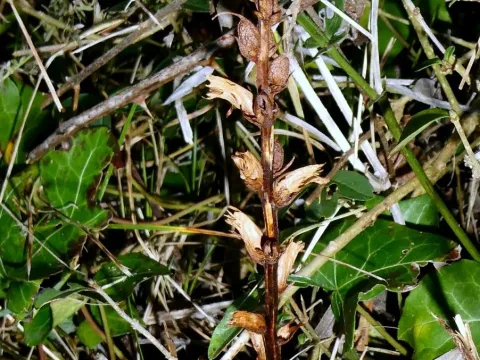
Ivy broomrape
Orobanche hederae
Ivy broomrape (Latin Orobanche hederae) is a specialized parasitic plant belonging to the Orobanchaceae family. As a holoparasite, it lacks chlorophyll entirely, meaning it cannot synthesize its own food and must derive all necessary nutrients directly from the roots of its host, typically Hedera helix.
What the section contains
Ivy broomrape
The native range of this species covers Europe, the Mediterranean region, and parts of Asia. It thrives in shaded, humid habitats where host populations are dense, such as woodlands, garden hedges, and shaded stone walls. Its survival is strictly tied to the presence of established ivy.
The plant typically manifests as a fleshy, vertical stem, reaching heights of 20–60 cm. Its color ranges from pale yellow to brownish-purple, often blending into the dark soil or shade. The inflorescence is a dense raceme of tubular flowers, which are essential for its identification during the flowering season.
The biological cycle is triggered by chemical germination stimulants released by the host roots. Without this specific interaction, the seeds of the broomrape remain dormant in the soil for extended periods, maintaining a persistent seed bank that makes eradication difficult in affected areas.
In terms of management, the focus is entirely on control rather than cultivation. Since it serves no agricultural purpose, gardeners and land managers focus on manual removal of the stalks before seeds mature. This limits the spread and protects ornamental ivy plantings from the systemic stress caused by the parasite.
The primary threat posed by this organism is the physical and physiological weakening of the host ivy. By tapping into the vascular system of the ivy, the broomrape siphons essential photosynthates and water, resulting in stunted growth and chlorosis of the ivy leaves.
Furthermore, the attachment points where the parasite penetrates the host roots can serve as sites for bacterial or fungal infections. This often leads to tissue decay, making the host vulnerable to further decline and reducing its longevity as a groundcover or ornamental wall climber.