
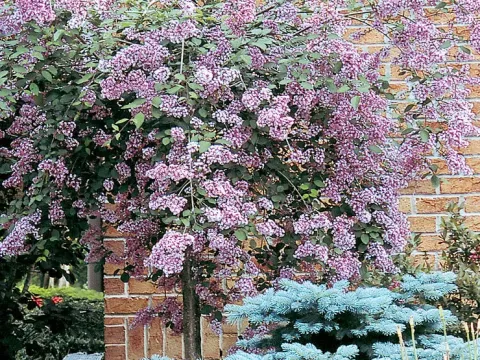
Julian's lilac
Syringa julianae
Julian's lilac (Syringa julianae) is a spectacular deciduous shrub belonging to the Oleaceae family. Originally native to western China, it grows in mountain forests and thickets. The plant is highly valued by gardeners for its compact habit, profuse flowering, and high decorative appeal throughout the growing season.
What the section contains
Julian's lilac
Botanically, this species is a dense shrub reaching a height of up to 2 meters. The leaves are broad-ovate with pointed tips and a pubescent underside. The inflorescences of Julian's lilac consist of dense panicles of small, highly fragrant, tubular flowers in shades of purple or light violet.
The plant has moderate climatic requirements, showing good frost resistance in temperate regions. It prefers open, sun-drenched locations but can tolerate light shade, making it a versatile choice for various garden zones. Proper site selection is crucial for achieving maximum blossom density.
When it comes to soil, Julian's lilac is quite demanding: it requires fertile, well-drained loams with a neutral to slightly alkaline pH. The shrub reacts very negatively to waterlogging and high groundwater levels; therefore, a drainage layer is mandatory when planting in heavy or clay-based soils.
Agrotechnical practices include regular watering during dry spells, spring pruning to maintain the desired crown shape, and deadheading spent blooms to encourage flower bud development for the following year. Its primary use is purely decorative, serving well in hedges, mixed borders, or as a focal point in a garden layout.
Common diseases for Syringa julianae include powdery mildew, which presents as a white coating on the foliage, and bacterial rot. Prevention involves thinning the crown to ensure adequate air circulation and reducing humidity levels around the foliage.
Among the pests, the lilac leaf miner, leaf rollers, and scale insects are the most problematic. Control measures involve timely application of systemic insecticides during the peak periods of spring growth to protect the health of the plant.