
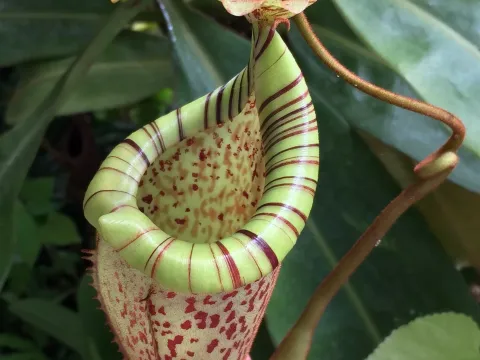
Nepenthes graciliflora
Nepenthes graciliflora
Nepenthes graciliflora is a specialized carnivorous plant species belonging to the Nepenthaceae family. It is native to the Philippine archipelago, primarily inhabiting montane tropical forests where it thrives in high humidity and moderate temperatures throughout the year.
What the section contains
Nepenthes graciliflora
For successful cultivation, a controlled environment is essential. The species requires daytime temperatures between 22°C and 28°C, with a slight drop at night. Maintaining high relative humidity, ideally above 70%, is crucial for the development of the plant's characteristic pitchers.
The substrate must be highly porous and nutrient-poor to mimic its natural epiphytic or terrestrial habitat. A blend of long-fiber sphagnum moss, pine bark, and coarse perlite is recommended to provide sufficient drainage while maintaining the necessary moisture retention.
Lighting should be bright, diffused, and persistent. In indoor settings, professional full-spectrum grow lights are preferred over natural sunlight to prevent leaf scorch. A photoperiod of at least 12 hours is necessary to ensure vigorous growth and the production of new traps.
Watering requirements are strict: only distilled, reverse osmosis, or pure rainwater should be used. The plant must be kept consistently moist but never waterlogged, as stagnant water in the root zone quickly leads to root rot and eventual plant death.
The most significant threats to Nepenthes graciliflora include sap-sucking pests such as mealybugs and spider mites. These pests thrive in dry conditions and can devastate the plant if not controlled through manual removal or safe, insecticidal soap treatments.
Fungal pathogens, particularly botrytis and root rot, represent the most common diseases in greenhouse environments. These are primarily caused by poor air circulation and excessive moisture, which can be mitigated through the use of small ventilation fans.
Nutrient toxicity is a common cause of crop failure. Because the plant has evolved to derive nutrients from captured insects, synthetic fertilizers can damage the root system. Any fertilization must be done with extreme caution using diluted foliar sprays.
Low humidity during the winter months often results in the premature drying of pitchers. Implementing automated fogging systems helps maintain the necessary microclimate, ensuring the plant remains healthy and continues to function effectively as a predator.
Environmental stress is often indicated by chlorosis or reddening of the leaves. Agronomists must monitor the light intensity and water quality closely, as even minor deviations in these parameters can lead to significant physiological setbacks for the crop.