
Banana
Musa L.
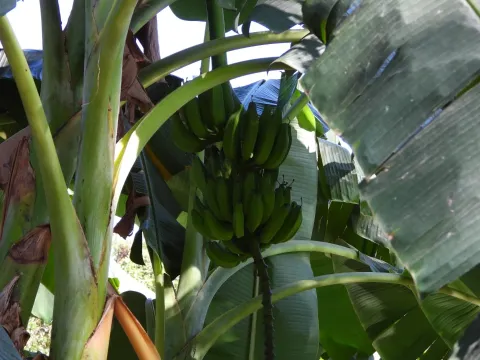
The banana (lat. Musa L.) is a perennial herbaceous plant belonging to the family Musaceae. Despite its tree-like appearance, it lacks a true woody trunk; instead, it features a pseudostem composed of tightly packed, overlapping leaf sheaths that support the heavy leaves.
What the section contains
 Abaca
Musa textilis Née
Abaca
Musa textilis Née
 Banana
Musa x paradisiaca L.
Banana
Musa x paradisiaca L.
 Japanese fiber banana
Musa basjoo Siebold & Zucc. ex Iinuma
Japanese fiber banana
Musa basjoo Siebold & Zucc. ex Iinuma
 Musa acuminata
 Colla
Musa acuminata
Musa acuminata Colla
 Musa balbisiana
 Colla
Musa balbisiana
Musa balbisiana Colla
 Musa itinerans
 Cheesman
Musa itinerans
Musa itinerans Cheesman
 Musa sumatrana
 Becc. ex André
Musa sumatrana
Musa sumatrana Becc. ex André
 Musa uranoscopos
 Lour.
Musa uranoscopos
Musa uranoscopos Lour.
 Musa velutina
 H. Wendl. & Drude
Musa velutina
Musa velutina H. Wendl. & Drude
 Sikkim banana
Musa sikkimensis Kurz
Sikkim banana
Musa sikkimensis Kurz
 Sishuangbanna banana
Musa itinerans Cheesman var. xishuangbannaensis Häkkinen
Sishuangbanna banana
Musa itinerans Cheesman var. xishuangbannaensis Häkkinen
Banana
Originating in the tropical regions of Southeast Asia and the Malay Archipelago, the plant is now cultivated globally across the equatorial belt. Major production centers are located in Central and South America, Africa, and parts of Asia, where high temperatures and regular rainfall prevail.
Banana plants thrive in temperatures ranging from +25°C to +30°C. They are highly sensitive to thermal stress, and temperatures dropping below +10°C significantly inhibit growth, while frost causes severe tissue damage and can lead to the total death of the pseudostem.
Optimal soil conditions include deep, well-draining loamy or sandy soils with a pH between 5.5 and 7.0. Because of their large surface area, banana plants have high transpiration rates and require consistent moisture, making irrigation essential in areas with seasonal dry spells.
Agronomic management involves periodic removal of suckers to ensure the main plant receives sufficient nutrients. Fertilization programs must focus on potassium, which is critical for fruit development, alongside nitrogen and phosphorus to support vegetative growth.
Bananas are a fundamental staple crop for millions and a major global trade commodity. Beyond direct consumption, they provide valuable fiber from the stalks of specific species and are a significant source of potassium, carbohydrates, and dietary vitamins for human nutrition.
Plantations face constant pressure from fungal pathogens, including Anthracnose, Verticillium wilt, Rhizoctonia, Sclerotinia, Brown spot, and various leaf spot diseases. These threats necessitate rigorous management strategies and the use of resistant cultivars.
Fruit rot is a major post-harvest concern, impacting both local yields and the quality of international shipments. Preventing the spread of these fungi requires strict hygiene during harvest and optimized conditions in refrigerated logistics chains.
The Root-knot nematode (Gallo nematode) is a persistent soil pest that affects roots, impairing the plant's ability to absorb water and nutrients. Integrated pest management, including the use of certified clean planting material, is vital to mitigate nematode infestations.
Harvesting is performed while the fruit is still mature green and firm. This ensures the banana can withstand the handling and transport process without bruising or premature ripening before reaching the destination market.
Once harvested, the bunches are washed to remove latex and other residues. They are then calibrated and packed. Controlled ripening in specialized chambers using ethylene gas is the final stage before the fruit is distributed to retail, ensuring consistent quality for consumers.